
Spades is one of the most popular trick-taking card games, combining teamwork, strategy, and careful bidding. While learning how to play is fairly straightforward, understanding Spades scoring is often the biggest challenge for new players. A single mistake in keeping score can completely change the outcome of a game.
Whether you’re playing casually with friends, joining online matches, or entering tournaments, knowing how points are awarded, how bags work, and when penalties apply is essential. Once you understand the scoring system, you’ll make smarter bids, avoid costly mistakes, and improve your chances of winning.
What Is Spades Scoring?
Spades scoring is the method used to determine which team wins the game based on successful bidding and trick-taking.
Unlike many card games where every trick has equal value, Spades rewards players for accurately predicting how many tricks they will win before each round begins.
Your team’s score depends on:
- Your total bid
- The number of tricks won
- Whether you overbid or underbid
- Nil or Blind Nil bids (if used)
- Accumulated bags
Because bidding is central to the game, success comes from both playing well and estimating your hand accurately.
Standard Spades Scoring Rules
Although house rules may vary, the following scoring system is the standard version used in most games.
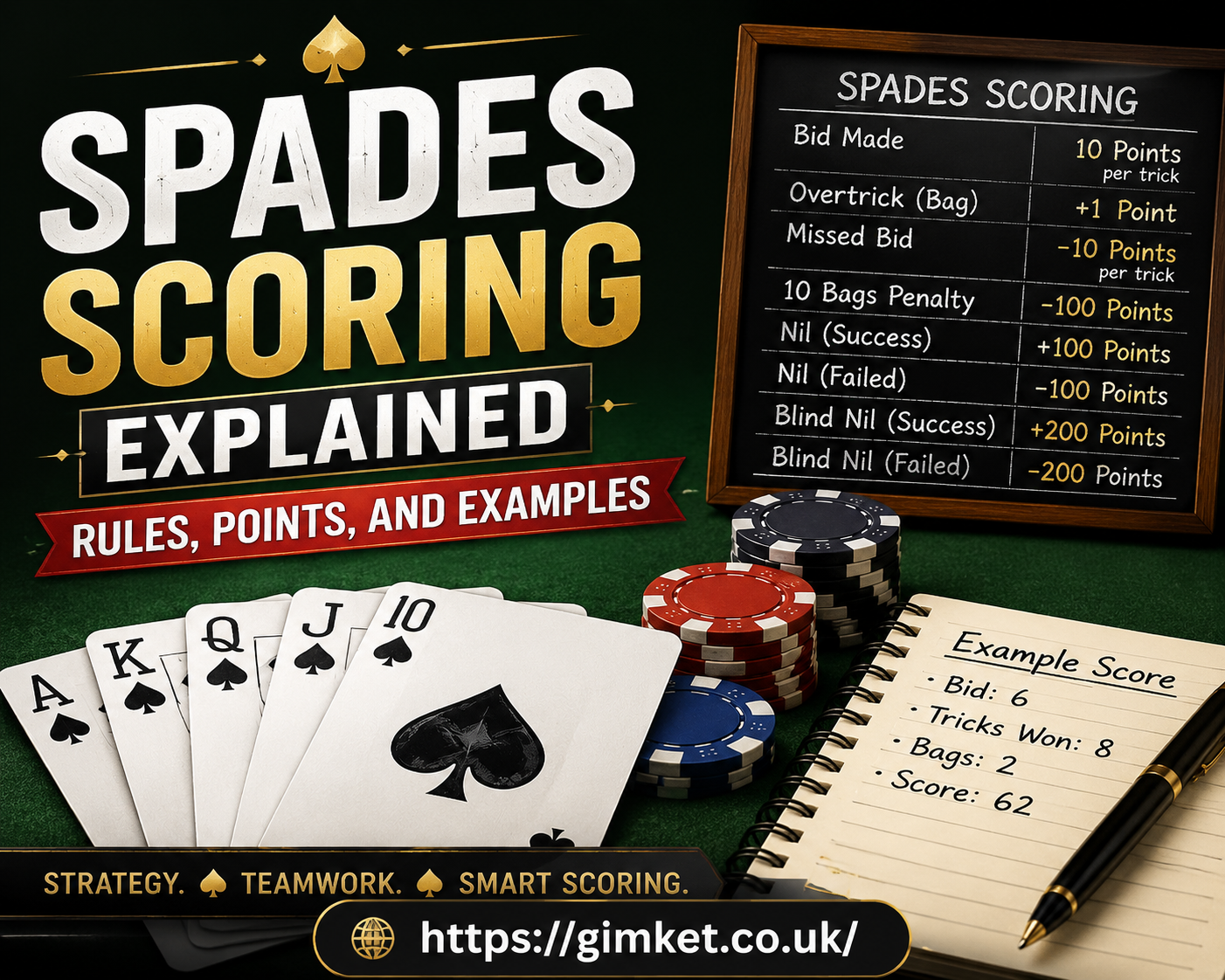
| Action | Points Awarded |
|---|---|
| Successfully make bid | 10 points per trick bid |
| Each overtrick (bag) | +1 point |
| Fail to make bid | Lose 10 points per trick bid |
| Reach 10 bags | -100 points |
| Successful Nil bid | +100 points |
| Failed Nil bid | -100 points |
| Successful Blind Nil | +200 points (common rule) |
| Failed Blind Nil | -200 points (common rule) |
Understanding Bids
Before each hand begins, every player estimates how many tricks they expect to win.
For example:
- Player A: 4
- Player B: 2
The partnership’s total bid is:
4 + 2 = 6 tricks
The team must win at least six tricks to make their contract.
Winning exactly six tricks or more fulfills the bid.
Winning fewer results in a penalty.
How Points Are Calculated
The basic scoring formula is simple.
Points = Bid × 10
For example:
| Team Bid | Tricks Won | Score |
|---|---|---|
| 5 | 5 | 50 |
| 6 | 6 | 60 |
| 7 | 7 | 70 |
| 8 | 8 | 80 |
Meeting the bid earns the full value.
What Are Bags?
A bag is an extra trick won beyond your team’s bid.
For example:
Team bid: 6
Actual tricks won: 8
Scoring:
- Bid made = 60 points
- Two extra tricks = 2 bags
- Total = 62 points
Although bags add one point each, collecting too many eventually results in a major penalty.
The 10-Bag Penalty
Most versions of Spades use a bag penalty to discourage intentionally taking unnecessary tricks.
When a team accumulates ten bags over multiple rounds:
- They lose 100 points.
- Their bag count resets by 10.
Example
Current bags: 8
Round:
- Bid: 5
- Tricks won: 7
New bags:
8 + 2 = 10
Penalty:
-100 points
Bag count returns to 0.
This rule rewards disciplined bidding rather than simply winning every possible trick.
What Happens If You Miss Your Bid?
Missing your bid is known as being set.
Example:
Bid: 7
Actual tricks won: 5
Instead of earning points, the team loses:
70 points
Even if you came close, the entire bid fails.
This is why accurate bidding is so important.
Nil Bids Explained
A Nil bid means a player predicts they will not win any tricks during the round.
It is a high-risk, high-reward strategy.
Successful Nil
If the player wins zero tricks:
+100 points
Failed Nil
If they win even one trick:
-100 points
The partner continues trying to make the team’s remaining bid.
Blind Nil
Some games allow Blind Nil.
The player declares they will win zero tricks before looking at their cards.
Typical scoring:
- Success: +200
- Failure: -200
Many home games modify these values, so agree on the rules before starting.
Complete Scoring Examples
Example 1
Team bid: 5
Tricks won: 5
Score:
50 points
Example 2
Team bid: 5
Tricks won: 7
Score:
- 50 for making bid
- 2 bags
Total:
52 points
Example 3
Team bid: 6
Tricks won: 4
Score:
-60 points
Example 4
Player bids Nil
Partner bids 5
Player wins zero tricks.
Team wins exactly five tricks.
Score:
- Nil bonus = +100
- Team bid = +50
Total:
150 points
Example 5
Player bids Nil
Accidentally wins one trick.
Partner makes the remaining bid.
Score:
- Nil penalty = -100
- Team bid = +50
Total:
-50 points
Sample Scorecard
| Round | Bid | Tricks Won | Bags Earned | Round Score | Total Score |
|---|---|---|---|---|---|
| 1 | 5 | 5 | 0 | 50 | 50 |
| 2 | 6 | 7 | 1 | 61 | 111 |
| 3 | 4 | 6 | 2 | 42 | 153 |
| 4 | 7 | 5 | 0 | -70 | 83 |
A running scorecard helps players track both points and accumulated bags accurately.
Common Spades Scoring Variations
Different groups often customize the rules.
Popular variations include:
| Rule | Common Variation |
|---|---|
| Winning score | 300, 500, or 1000 points |
| Bag penalty | Every 10 bags or every 5 bags |
| Nil bonus | 50 or 100 points |
| Blind Nil | 100 or 200 points |
| Sandbags | Optional penalty systems |
| Jokers | Included or excluded depending on deck |
Always confirm the scoring rules before starting a game.
Tips for Better Spades Scoring
Bid Conservatively
Overestimating your hand can lead to heavy penalties.
Avoid Too Many Bags
One or two bags occasionally are fine, but repeatedly collecting extras can cost 100 points.
Communicate Through Play
Partners cannot discuss bids during play, but careful card choices can signal strength.
Learn When to Attempt Nil
Nil bids are most effective with weak Spades scoring hands that contain few high cards.
Track Opponents’ Bags
Knowing when the opposing team is close to a bag penalty can influence your strategy.
Common Scoring Mistakes
Many beginners lose points because they misunderstand the rules.
Watch out for these mistakes:
- Forgetting to record bags.
- Counting tricks incorrectly.
- Miscalculating partnership bids.
- Ignoring Nil bonuses or penalties.
- Applying house rules inconsistently.
- Forgetting the 10-bag penalty.
Keeping a written score sheet reduces these errors.
Strategy
Scoring vs. Winning Tricks
One of the biggest lessons in Spades is that taking the most tricks does not always win the game.
For example:
Team A bids 5 and wins 6.
Score: 51
Team B bids 8 and wins exactly 8.
Score: 80
Although Team A won an extra trick, Team B earned significantly more points because they accurately matched their bid.
Successful players focus on efficient scoring rather than simply capturing every trick.
Frequently Asked Questions
1. How many points is each bid worth in Spades?
Each successfully bid trick is generally worth 10 points. A bid of six tricks earns 60 points if completed.
2. What is a bag in Spades?
A bag is any trick won beyond your team’s bid. Each bag usually adds one point but contributes toward a future bag penalty.
3. What happens after collecting 10 bags?
In the standard rules, accumulating 10 bags results in a 100-point deduction, and the bag count resets by 10.
4. What is a Nil bid?
A Nil bid is a declaration that a player will win no tricks during the hand. Success earns a bonus, while failure results in a penalty.
5. Can Spades scoring rules vary?
Yes. Many groups use different winning scores, Nil bonuses, Blind Nil values, and bag penalty rules. Always agree on the rules before playing.
6. What score wins a game of Spades?
Most traditional games end when a team reaches 500 points, though some groups play to 300 or 1,000 points.
7. Do bags always count as positive points?
Yes, each bag typically adds one point immediately. However, accumulating too many bags eventually leads to a significant penalty, making excessive bags a long-term disadvantage.
Conclusion
Understanding Spades scoring is the foundation of becoming a better player. While the rules may seem complicated at first, they follow a logical system built around accurate bidding, successful trick-taking, and careful risk management. Learning how bids, bags, penalties, Nil bids, and bonus points interact allows you to make smarter strategic decisions throughout every game.
Whether you’re playing casually with family or competing in organized tournaments, keeping an accurate score ensures fair play and helps everyone enjoy the game. With practice, you’ll spend less time calculating points and more time focusing on the strategy that makes Spades one of the most engaging trick-taking card games.