
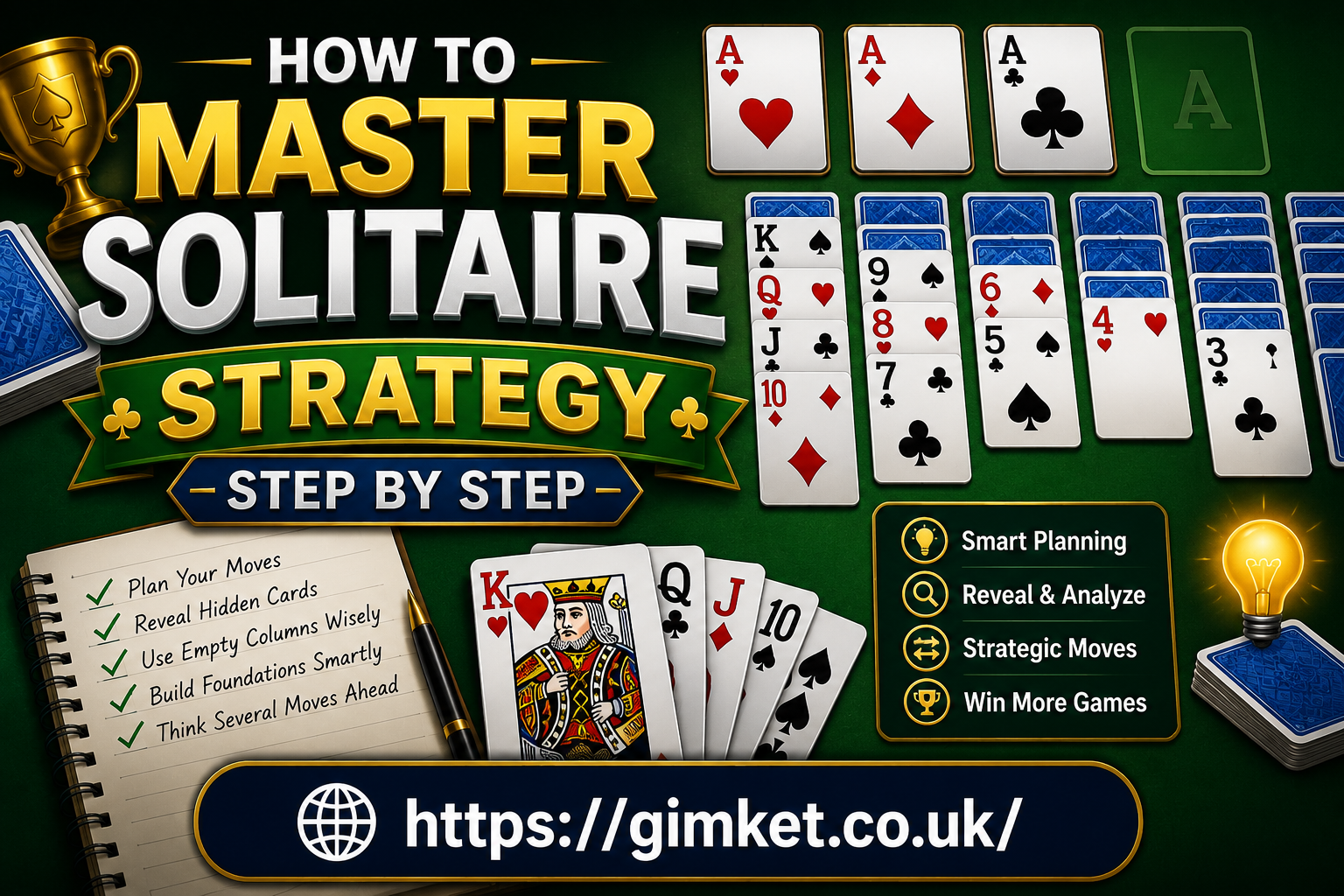
Solitaire is one of the world’s most popular card games because it combines luck with thoughtful decision-making. While every deal is different, the way you play your cards can dramatically affect your chances of winning. Learning an effective Solitaire Strategy helps you make smarter moves, avoid common mistakes, and increase your success over time.
Many players believe Solitaire is purely a game of chance. Although luck determines the initial card layout, strategic decisions influence how many opportunities you create throughout the game. Knowing when to reveal hidden cards, when to move cards to the foundation, and when to use empty tableau columns can make the difference between winning and getting stuck.
Understanding the Basics of Solitaire
Before applying advanced techniques, it’s important to understand the objective of Solitaire.
In the classic Klondike version, your goal is to move every card to four foundation piles, one for each suit, arranged from Ace through King.
The game consists of:
- Tableau columns
- Stock pile
- Waste pile
- Foundation piles
Success depends on uncovering hidden cards while organizing the tableau efficiently.
Why Solitaire Strategy Matters
Many games cannot be won regardless of skill because of the initial card arrangement. However, skilled players consistently win more games because they make better decisions.
A strong Solitaire Strategy helps you:
- Reveal more hidden cards
- Prevent dead-end positions
- Increase available moves
- Reduce unnecessary risks
- Improve long-term winning percentages
Rather than reacting to each move individually, experienced players think several steps ahead.
Reveal Hidden Cards First
The hidden face-down cards in the tableau limit your options.
Whenever possible, prioritize moves that expose these hidden cards.
For example:
Instead of immediately moving a card to the foundation, ask yourself:
“Will another move uncover a hidden card first?”
Every revealed card increases your available choices and reduces uncertainty.
Don’t Rush Cards to the Foundation
One of the most common beginner mistakes is moving every available card to the foundation immediately.
Although this seems logical, it can actually reduce your flexibility.
For instance:
If a low-value card remains in the tableau, it might help you build alternating color sequences.
Only move cards to the foundation when you’re confident they won’t be needed again.
Build Long Tableau Sequences
The tableau is where most strategic play occurs.
Long alternating-color sequences allow you to:
- Move larger groups together
- Create empty columns
- Access hidden cards faster
Example:
Instead of moving individual cards repeatedly, create complete sequences that can be transferred efficiently.
This approach creates more opportunities later in the game.
Empty Tableau Columns Wisely
An empty tableau column is one of your strongest strategic tools.
Whenever possible, save empty spaces for Kings or long card sequences.
Avoid filling empty columns with temporary moves that don’t improve your overall position.
Good uses include:
- Moving a King with a long sequence
- Rearranging multiple columns
- Revealing additional hidden cards
Poor planning can waste these valuable spaces.
Examine All Possible Moves
Never make the first available move automatically.
Pause briefly and compare every legal move.
Ask yourself:
- Which move reveals a hidden card?
- Which move creates more options?
- Which move limits future flexibility?
Often, the second or third possible move is the strongest choice.
Manage the Stock Pile Carefully
The stock pile provides additional opportunities, but it should be used thoughtfully.
When cycling through the deck:
- Remember previously seen cards.
- Plan future moves before drawing again.
- Avoid unnecessary recycling.
Experienced players mentally track important cards such as:
- Aces
- Twos
- Kings
- Missing colors
This helps them prepare future plays.
Free the Aces Early
Aces begin every foundation pile.
The sooner you uncover them, the sooner foundation building can begin.
However, don’t sacrifice a better tableau position simply to expose an Ace.
Balance immediate gains with long-term flexibility.
Think Several Moves Ahead
Good Solitaire players don’t think one move ahead.
They often consider three, four, or even five future moves.
For example:
Moving one red Jack today might allow:
- A hidden card to appear
- An empty column tomorrow
- A King placement later
- A complete sequence afterward
Strategic planning leads to stronger results than reactive play.
Common Solitaire Strategy Mistakes
Avoid these frequent errors.
| Mistake | Better Alternative |
|---|---|
| Moving every card to foundations | Keep useful cards available |
| Ignoring hidden cards | Reveal face-down cards quickly |
| Filling empty columns immediately | Save them for Kings and sequences |
| Playing too quickly | Evaluate all possible moves |
| Focusing only on one tableau column | Balance progress across all columns |
Recognizing these mistakes is one of the fastest ways to improve.
Beginner vs Advanced Solitaire Strategy
| Beginner Approach | Advanced Approach |
|---|---|
| Makes the first legal move | Evaluates every option |
| Moves cards immediately | Plans several turns ahead |
| Prioritizes foundations | Prioritizes flexibility |
| Ignores future consequences | Thinks strategically |
| Relies on luck | Maximizes winning chances |
Small improvements in decision-making add up over hundreds of games.
Practical Example
Imagine you have two possible moves:
Option A
Move a Five to the foundation.
Option B
Move the same Five within the tableau, exposing a hidden card.
Most experienced players choose Option B because revealing hidden cards increases future opportunities.
The hidden card may unlock:
- An Ace
- A King
- Another sequence
- Multiple future moves
This demonstrates why immediate progress isn’t always the best progress.
How to Improve Faster
Improvement comes through deliberate practice.
Consider these habits:
- Finish every game, even difficult ones.
- Review mistakes after losing.
- Experiment with different move orders.
- Focus on revealing hidden cards.
- Practice consistently rather than playing long sessions occasionally.
Over time, you’ll recognize common patterns naturally.
Does Luck Still Matter?
Yes.
Some Solitaire games are unwinnable regardless of skill because of the original shuffle.
However, strategy still matters because:
- Better players win more winnable games.
- Good decisions reduce avoidable mistakes.
- Efficient play increases success over many games.
Think of luck as determining the challenge, while strategy determines how well you respond.
Tips for Consistent Success
To build a reliable Solitaire Strategy, remember these principles:
- Reveal hidden cards whenever possible.
- Don’t rush cards to the foundations.
- Preserve flexibility.
- Think several moves ahead.
- Create empty tableau columns strategically.
- Compare multiple possible moves.
- Keep long sequences together.
- Learn from every completed game.
Following these habits consistently will improve your results far more than relying on luck alone.
Frequently Asked Questions
1. What is the best Solitaire Strategy?
The best strategy is to reveal hidden cards early, avoid unnecessary foundation moves, create empty tableau columns strategically, and plan several moves ahead before making decisions.
2. Is Solitaire mostly luck or skill?
Solitaire involves both luck and skill. While the initial shuffle is random, strategic decisions significantly improve your chances of winning playable games.
3. Should I move cards to the foundation immediately?
Not always. Sometimes keeping cards in the tableau provides greater flexibility and creates more opportunities to uncover hidden cards.
4. Why are hidden cards so important?
Hidden cards limit your available moves. Revealing them quickly increases your options and improves your chances of completing the game.
5. How can I improve my Solitaire win rate?
Practice regularly, think ahead, reveal hidden cards first, evaluate every possible move, and avoid rushing important decisions.
6. What is the biggest mistake beginners make?
Many beginners move cards to the foundation too quickly without considering how those cards might help build tableau sequences later.
7. Does every Solitaire game have a winning solution?
No. Depending on the shuffle, some games are mathematically unwinnable. However, strong strategy helps you win a higher percentage of games that are solvable.
Conclusion
Mastering Solitaire Strategy is about making thoughtful decisions rather than relying on luck. By focusing on revealing hidden cards, preserving flexibility in the tableau, using empty columns wisely, and planning several moves ahead, you can steadily improve your performance. While not every game can be won, applying these proven techniques will increase your success rate and make each game more enjoyable. With consistent practice and careful observation, you’ll develop the confidence and strategic thinking needed to tackle even the most challenging Solitaire layouts.