
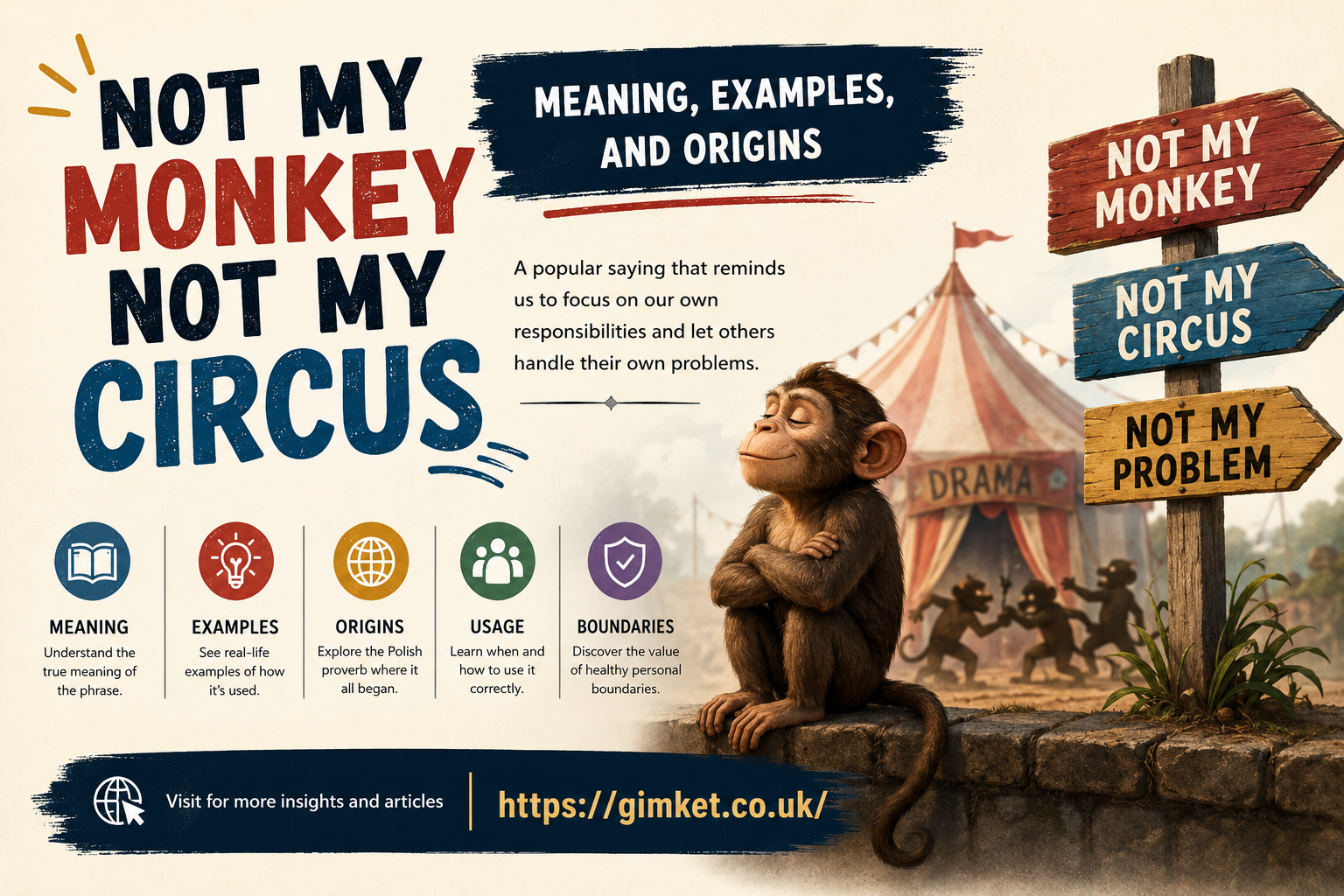
Have you ever found yourself caught in someone else’s drama and wished you had the perfect phrase to step away? That’s exactly where Not My Monkey Not My Circus comes in. This well-known expression reminds us that not every problem is ours to solve.
Although the saying has gained popularity in English-speaking countries, its roots lie elsewhere, and its message is surprisingly timeless. It encourages healthy boundaries, personal responsibility, and the wisdom of knowing when to get involved—and when to walk away.
In this guide, you’ll discover the meaning of Not My Monkey Not My Circus, where it originated, how to use it correctly, real-life examples, common misunderstandings, and why it has become such a widely quoted expression.
Key Takeaways
- Not My Monkey Not My Circus means someone else’s problem is not your responsibility.
- The phrase originated as a translation of a Polish proverb.
- It encourages setting healthy personal and professional boundaries.
- The expression is commonly used in workplaces, families, and social situations.
- Understanding when to use the phrase helps avoid unnecessary stress and conflict.
Main Article
What Does “Not My Monkey Not My Circus” Mean?
The expression Not My Monkey Not My Circus means that a situation, conflict, or responsibility belongs to someone else—not you.
Rather than suggesting indifference, the phrase emphasizes recognizing the difference between problems you can influence and those that are outside your responsibility.
In simple terms, it means:
“This isn’t my issue to manage.”
People often use the saying to politely distance themselves from unnecessary conflict or responsibilities that belong to others.
For example:
- Two coworkers argue about a project that doesn’t involve you.
- Neighbors disagree over a property line.
- Family members argue over an inheritance.
In each case, saying Not My Monkey Not My Circus communicates that you are choosing not to become involved.
The Origin of “Not My Monkey Not My Circus”
The phrase comes from the Polish proverb:
“Nie mój cyrk, nie moje małpy.”
Its literal English translation is:
“Not my circus, not my monkeys.”
Over time, English speakers also began using the variation:
“Not My Monkey Not My Circus.”
While the word order differs slightly, both versions communicate the same idea.
The proverb became more widely known outside Poland through books, travel writing, international workplaces, and social media. Its memorable imagery helped it spread quickly across cultures.
Today, it is recognized as a practical saying about personal responsibility and emotional boundaries.
Why the Expression Is So Popular
Modern life often exposes people to conflicts that have little to do with them.
Whether at work, online, or within families, people frequently feel pressure to solve problems that are not theirs.
The popularity of Not My Monkey Not My Circus comes from its ability to express an important life lesson in just a few words.
It encourages people to:
- Protect their mental well-being.
- Avoid unnecessary stress.
- Respect other people’s responsibilities.
- Focus on what they can control.
- Reduce emotional exhaustion.
These ideas have become increasingly relevant in today’s fast-paced world.
When Should You Use “Not My Monkey Not My Circus”?
The phrase works best when you want to acknowledge a situation without becoming responsible for it.
Common situations include:
Workplace Conflicts
Imagine two departments arguing over budgets.
If the disagreement has nothing to do with your role, you might think:
“Not My Monkey Not My Circus.”
This helps remind yourself not to become distracted by issues outside your responsibilities.
Family Drama
Extended family disagreements can easily pull people into unnecessary conflict.
If relatives are arguing over personal matters that do not concern you, the expression can serve as a reminder to maintain healthy boundaries.
Social Situations
Friends sometimes expect others to mediate disagreements.
Rather than choosing sides, someone may quietly decide that the issue belongs to the people involved.
Online Arguments
Social media has created endless opportunities for public disagreements.
Instead of joining every debate, many people adopt the mindset of Not My Monkey Not My Circus to preserve their peace of mind.
Situations Where You Should Not Use It
Although the phrase promotes healthy boundaries, it should not be used to avoid genuine responsibility.
For example, it is inappropriate when:
- A child needs protection.
- Someone is being bullied.
- Workplace safety is at risk.
- Illegal activity is occurring.
- A family member genuinely needs emergency help.
Healthy boundaries should never replace compassion or ethical responsibility.
Real-Life Examples
Here are some everyday examples of how the phrase can be used naturally.
Example 1
Sarah notices two coworkers arguing loudly.
She quietly returns to her own work and thinks:
“Not My Monkey Not My Circus.”
Example 2
Tom’s neighbors are arguing over parking spaces.
Since it doesn’t affect him, he decides not to become involved.
Example 3
Emma’s friends ask her to take sides in their disagreement.
She politely says she hopes they resolve it themselves instead of joining the conflict.
Example 4
An employee receives emails about a project handled by another department.
Rather than interfering, they forward the message to the correct team.
Similar Expressions
English has several sayings that communicate a similar idea.
| Expression | Meaning |
|---|---|
| Not My Monkey Not My Circus | Someone else’s responsibility |
| Not my problem | I am not responsible |
| Stay in your lane | Focus on your own responsibilities |
| Mind your own business | Avoid interfering in others’ affairs |
| That’s not my concern | Outside my responsibility |
| Let them handle it | Allow responsible people to solve the issue |
Although these phrases are similar, Not My Monkey Not My Circus stands out because it uses vivid imagery that people tend to remember.
Why Healthy Boundaries Matter
One reason the phrase resonates with so many people is that it reflects an important principle of emotional well-being: healthy boundaries.
Healthy boundaries help people:
- Manage stress more effectively.
- Avoid emotional burnout.
- Improve workplace productivity.
- Build healthier relationships.
- Focus energy on meaningful responsibilities.
Recognizing which problems belong to you—and which do not—is an important life skill.
Common Misunderstandings
Some people believe the phrase encourages selfishness.
In reality, it promotes responsibility rather than avoidance.
It does not mean:
- Ignore everyone.
- Never help others.
- Refuse kindness.
- Avoid teamwork.
Instead, it means understanding where your responsibility begins and ends.
Helping someone voluntarily is very different from feeling obligated to solve every problem around you.
Why the Phrase Continues to Grow in Popularity
Several factors explain why Not My Monkey Not My Circus has become increasingly common.
Easy to Remember
The unusual image of monkeys in a circus makes the saying memorable.
Universal Message
Every culture experiences unnecessary conflict and misplaced responsibility.
Useful in Everyday Life
The phrase applies equally well to:
- Families
- Friendships
- Offices
- Schools
- Online communities
- Businesses
Encourages Emotional Intelligence
Rather than reacting impulsively, the expression encourages thoughtful decision-making and emotional self-control.
Practical Tips for Using the Phrase
If you want to use Not My Monkey Not My Circus respectfully, keep these tips in mind:
- Use it privately when reminding yourself to maintain boundaries.
- Avoid saying it in a way that sounds dismissive toward someone who genuinely needs help.
- Consider whether the situation truly falls outside your responsibility.
- Balance healthy boundaries with empathy.
- Remember that choosing not to intervene is sometimes the wisest decision.
Frequently Asked Questions
What does Not My Monkey Not My Circus mean?
It means a problem or responsibility belongs to someone else, and you choose not to become involved unnecessarily.
Where did Not My Monkey Not My Circus originate?
The expression comes from the Polish proverb “Nie mój cyrk, nie moje małpy,” which translates to “Not my circus, not my monkeys.”
Is Not My Monkey Not My Circus considered rude?
Not necessarily. It depends on the context and tone. It is generally used to express healthy boundaries rather than disrespect.
Is Not My Monkey Not My Circus the same as “Not my problem”?
They are similar, but the circus expression often emphasizes setting boundaries rather than dismissing responsibility entirely.
Can I use the phrase in professional settings?
Yes. Many professionals use the idea behind the phrase to stay focused on their responsibilities and avoid becoming involved in unrelated workplace conflicts.
Why has the phrase become so popular?
Its memorable imagery, practical wisdom, and relevance to modern life have made it widely shared in conversations, books, workplaces, and social media.
Conclusion
Not My Monkey Not My Circus is more than a memorable saying—it is a practical reminder to focus on the responsibilities that truly belong to you. Originating from a Polish proverb, the expression has found worldwide popularity because it captures an essential life lesson in a few simple words.
Whether you’re navigating workplace disagreements, family conflicts, or online debates, understanding when to step back can reduce stress and improve your emotional well-being. At the same time, it’s important to remember that healthy boundaries should never replace compassion or responsibility when someone genuinely needs help.
By using Not My Monkey Not My Circus thoughtfully, you can protect your time, energy, and peace of mind while allowing others to take ownership of the challenges that are rightfully theirs.