
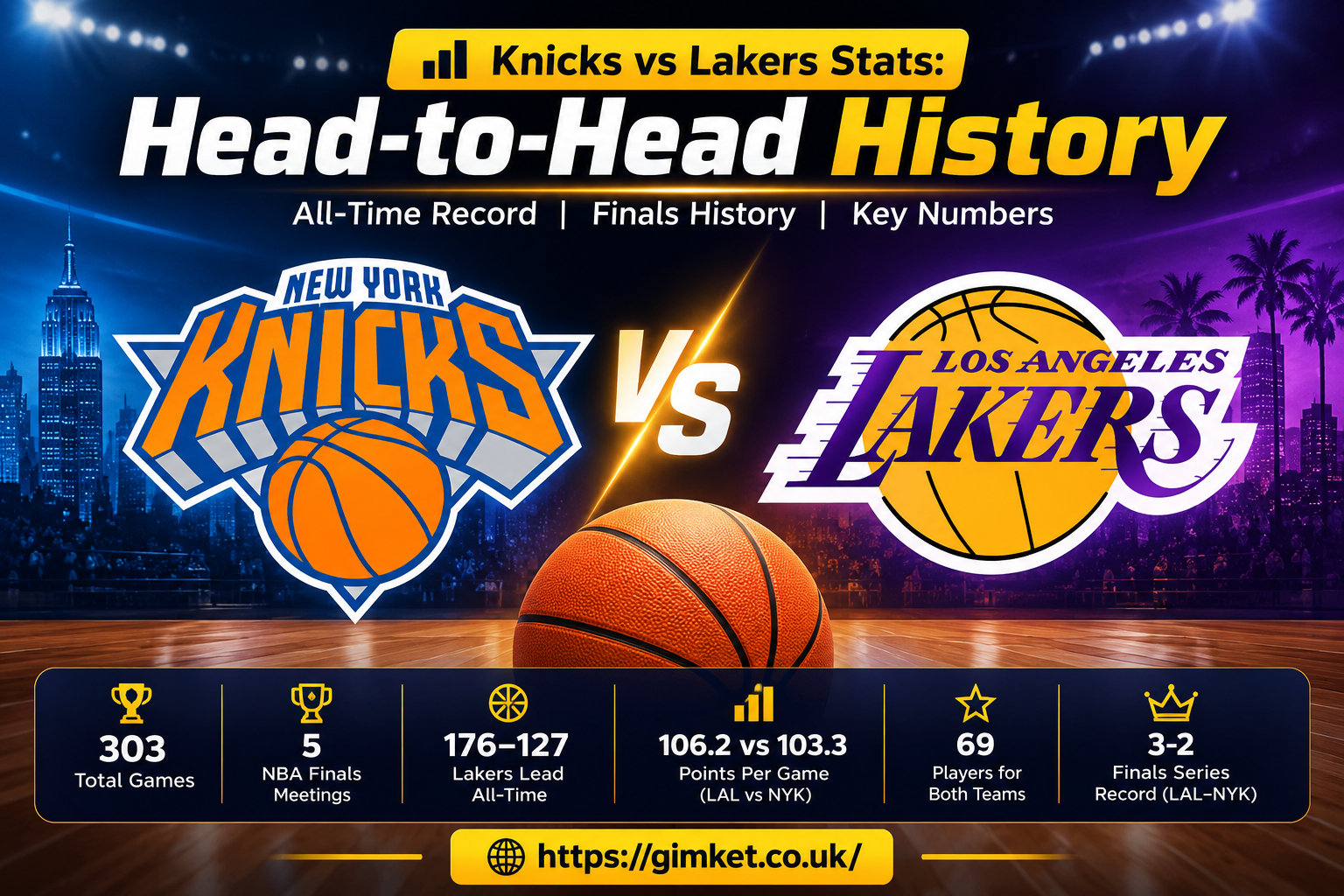
The Knicks vs Lakers stats tell the story of one of the NBA’s most recognizable cross-conference rivalries. Although the New York Knicks and Los Angeles Lakers do not meet as frequently as teams from the same conference, their history stretches across generations, from the Minneapolis Lakers era to the modern NBA.
Through the 2025-26 season, the teams have faced each other 303 times, including regular-season and playoff games. The Lakers hold the overall advantage with 176 wins to the Knicks’ 127, while the Lakers have also scored more points across those meetings.
But the overall record only tells part of the story. These franchises have also met in multiple NBA Finals, including memorable championship series in 1952, 1953, 1970, 1972, and 1973. Those series featured legendary players such as George Mikan, Jerry West, Wilt Chamberlain, Willis Reed, and Walt Frazier.
Knicks vs Lakers All-Time Head-to-Head Record
The simplest way to understand the rivalry is to start with the overall numbers.
| Statistic | Knicks | Lakers |
|---|---|---|
| Total meetings | 303 | 303 |
| Wins | 127 | 176 |
| Losses | 176 | 127 |
| Win percentage | 41.9% | 58.1% |
| Points scored | 31,299 | 32,176 |
| Points per game | 103.3 | 106.2 |
These figures include the Lakers franchise under both its Minneapolis Lakers and Los Angeles Lakers identities. Basketball-Reference lists 303 meetings between the franchises through the 2025-26 season.
The Lakers therefore have a clear statistical advantage. They have won roughly 58% of the meetings, while New York has won roughly 42%.
The scoring difference is also notable. Los Angeles has scored 32,176 points in the series compared with New York’s 31,299, a difference of 877 points across 303 games. That works out to an average scoring advantage of about 2.9 points per game for the Lakers.
What the Head-to-Head Numbers Really Mean
An all-time record is useful, but it needs context.
The rivalry spans several different eras of professional basketball. The Lakers’ history includes their Minneapolis years before the franchise moved to Los Angeles, while the Knicks have remained based in New York.
That means the 303-game sample covers dramatic changes in:
- Playing style
- League rules
- Offensive efficiency
- Pace of play
- Three-point shooting
- Defensive schemes
- Roster construction
- NBA expansion
A game from the early 1950s cannot be compared directly with a modern NBA matchup simply by looking at the final score.
For that reason, the best way to analyze Knicks vs Lakers stats is to combine the overall record with specific periods and postseason meetings.
Regular-Season Scoring Comparison
Across their overall head-to-head history, the Lakers have averaged 106.2 points per game, while the Knicks have averaged 103.3.
That difference is relatively modest considering the rivalry covers more than 300 games.
It suggests that Los Angeles’ advantage has not simply come from consistently overwhelming New York. Instead, the cumulative record reflects the Lakers’ ability to win more often across many different generations.
Modern scoring numbers also need to be interpreted differently from historical ones. NBA offenses generally produce more points today than they did several decades ago, so comparing raw scoring totals across eras can be misleading.
Knicks vs Lakers Finals History
The most important games in the rivalry came when the two teams met for the NBA championship.
They have faced one another in the NBA Finals five times.
| Year | Winner | Series Result |
|---|---|---|
| 1952 | Minneapolis Lakers | Lakers 4-3 |
| 1953 | Minneapolis Lakers | Lakers 4-1 |
| 1970 | New York Knicks | Knicks 4-3 |
| 1972 | Los Angeles Lakers | Lakers 4-1 |
| 1973 | New York Knicks | Knicks 4-1 |
The Finals record is therefore 3-2 in favor of the Lakers in series won.
1952 NBA Finals
The first Finals meeting came in 1952, when the New York Knicks faced the Minneapolis Lakers.
The Lakers won the championship series 4-3. The series went the full seven games, making it one of the earliest examples of a highly competitive postseason matchup between these franchises.
George Mikan was particularly important for Minneapolis. He finished the 1952 playoffs as the scoring leader with 307 points and also led all players in rebounds with 207.
1953 NBA Finals
The franchises met again in the 1953 Finals.
This time, Minneapolis won more comfortably, taking the series 4-1. George Mikan again dominated the statistical headlines, leading the playoffs in scoring with 238 points and rebounding with 185.
These first two Finals established the Lakers as the stronger team in the early championship-era meetings.
The 1970 Finals: Knicks Win a Classic
The rivalry took another major turn in 1970.
The Knicks defeated the Lakers 4-3 in a seven-game Finals series. New York’s championship team featured stars including Willis Reed and Walt Frazier, while Los Angeles relied heavily on Jerry West and Wilt Chamberlain.
Willis Reed was named Finals MVP and averaged 23.0 points, 10.5 rebounds, and 2.8 assists during the series.
One of the defining statistical performances came in Game 7. New York won the deciding game 113-99, completing the seven-game championship victory.
The series helped establish the Knicks as one of the NBA’s elite teams of the early 1970s.
The 1972 Finals: Lakers Respond
Two years later, the Lakers and Knicks met again in the Finals.
This time, Los Angeles won 4-1. The Lakers took the championship behind a historically strong team led by Wilt Chamberlain, Jerry West, Gail Goodrich, and other key contributors.
The series began with a surprising Knicks victory, as New York won Game 1 114-92 in Los Angeles. The Lakers responded by winning the next four games.
The result gave Los Angeles another championship against New York and temporarily shifted the postseason balance back toward the Lakers.
The 1973 Finals: Knicks Take Another Title
The teams returned to the Finals in 1973, creating an immediate opportunity for another chapter in their rivalry.
This time, the Knicks won 4-1. New York lost Game 1 but responded by winning four consecutive games to claim the championship.
Willis Reed was again the Finals MVP, averaging 16.4 points, 9.2 rebounds, and 2.6 assists.
The 1973 series remains particularly important because it gave New York its second championship of the decade and its second Finals victory over the Lakers in four years.
Knicks vs Lakers Stats: Key Historical Trends
Looking beyond wins and losses reveals several useful trends.
1. The Lakers Have the Overall Edge
The most obvious trend is Los Angeles’ 176-127 advantage.
The Lakers’ lead is substantial enough to establish a clear historical edge, even though the Knicks have enjoyed periods of success.
2. The Scoring Gap Is Smaller Than the Win Gap
Los Angeles has a 49-game advantage in victories, but its average scoring edge is only about three points per game.
That distinction matters.
It suggests that the historical difference between the teams is not accurately represented by one overwhelming scoring margin. Instead, many close games, overtime contests, and era-specific results contribute to the overall record.
3. The Rivalry Has Produced Championship Drama
Five Finals meetings make this more than a routine regular-season matchup.
The teams have played 29 Finals games against one another across those five series. The Lakers won 17 of those games, while the Knicks won 12. That gives Los Angeles a 17-12 Finals game record against New York. This is calculated directly from the series results documented for 1952, 1953, 1970, 1972, and 1973.
Comparing the Franchises Beyond Head-to-Head Games
Head-to-head statistics do not exist in isolation.
The Lakers have historically been one of the NBA’s most successful franchises. Through 2025-26, Basketball-Reference lists Los Angeles with 17 championships and 66 playoff appearances.
The Knicks have also enjoyed significant historical success, although less frequently. Through 2025-26, Basketball-Reference lists New York with three championships and 47 playoff appearances.
This broader franchise context helps explain why Knicks vs Lakers games have attracted so much attention. Both organizations have produced championship teams and Hall of Fame players across multiple generations.
Legendary Players Connected to the Rivalry
The statistical history of Knicks vs Lakers is inseparable from the players who defined each era.
Knicks Legends
New York’s historical statistical leaders include:
- Patrick Ewing
- Walt Frazier
- Willis Reed
- Bill Bradley
- Charles Oakley
- Allan Houston
Patrick Ewing is the Knicks’ all-time leader in games played, with 1,039, while Walt Frazier ranks second with 759.
Lakers Legends
The Lakers’ side of the rivalry includes an even broader collection of iconic players, including:
- George Mikan
- Jerry West
- Wilt Chamberlain
- Kareem Abdul-Jabbar
- Magic Johnson
- Kobe Bryant
- Shaquille O’Neal
- LeBron James
Different generations produced different statistical profiles. Early Lakers teams were built around dominant interior play, while later teams incorporated faster offenses, perimeter shooting, and increasingly sophisticated offensive systems.
Players Who Have Played for Both Teams
The rivalry has also created an interesting connection between the two franchises: numerous players have worn both uniforms.
Basketball-Reference identifies 69 players who have played for both the Knicks and Lakers. Among the notable names are Carmelo Anthony, Dick Barnett, Tyson Chandler, Bob McAdoo, and Glen Rice.
Carmelo Anthony is an especially interesting example. With New York, he averaged 24.7 points, 7.0 rebounds, and 3.2 assists over 412 games. With the Lakers, he averaged 13.3 points, 4.2 rebounds, and 1.0 assist over 69 games.
This illustrates why franchise statistics should not automatically be treated as direct comparisons of individual players. A player’s role, age, teammates, coaching environment, and playing time can change substantially after moving between teams.
How to Interpret Knicks vs Lakers Stats
If you’re researching a particular Knicks-Lakers matchup, it helps to separate statistics into several categories.
Head-to-Head Record
This answers the basic question:
Which team has won more games historically?
The answer is the Lakers, 176-127 through 2025-26.
Scoring
Points per game provide context about offensive production. Historically, the Lakers have averaged 106.2 points against the Knicks, compared with New York’s 103.3.
Postseason Performance
Regular-season statistics tell only part of the story. The five Finals meetings reveal a much more competitive championship history, with the Lakers winning three series and the Knicks winning two.
Individual Statistics
Points, rebounds, assists, shooting percentages, steals, blocks, and turnovers can explain why a particular game or series developed the way it did.
For modern games, advanced metrics such as true shooting percentage, usage rate, effective field-goal percentage, offensive rating, defensive rating, and net rating can provide additional context.
Why Historical Stats Need Era Context
One of the biggest mistakes when comparing historical NBA statistics is treating every season as if it were played under identical conditions.
The NBA of the 1950s was dramatically different from the NBA of the 2020s.
For example:
- The three-point line did not exist for most of the rivalry’s early history.
- Pace has changed considerably across eras.
- Rules governing defense have evolved.
- Training and sports science have advanced.
- Player roles have changed.
- The value of three-point shooting has transformed offensive strategy.
Consequently, a raw points-per-game comparison between a 1950s Lakers team and a modern Knicks team would provide limited insight.
Era-adjusted statistics and efficiency metrics are often more useful when comparing players or teams across generations.
What Makes Knicks vs Lakers Stats Interesting?
The appeal of this matchup comes from the combination of history, market size, star power, and championship pedigree.
New York and Los Angeles are two of the NBA’s most prominent basketball markets. Their franchises have produced multiple generations of iconic players and teams.
The rivalry also has an unusual statistical profile: Los Angeles owns the stronger overall head-to-head record, Knicks vs Lakers Stats but New York has won two of the five championship series between them.
That contrast makes the matchup more interesting than simply looking at the all-time win column.
Frequently Asked Questions
Who has the better Knicks vs Lakers all-time record?
The Los Angeles Lakers have the better record. Through the 2025-26 season, the Lakers lead the Knicks 176-127 in 303 total meetings.
How many times have the Knicks and Lakers played?
The franchises have played 303 games against each other through the 2025-26 season. The figure includes their regular-season and playoff meetings.
Who has scored more points in Knicks vs Lakers games?
The Lakers have scored more overall points. Los Angeles has 32,176 points compared with New York’s 31,299 across their head-to-head history.
How many times have the Knicks and Lakers met in the NBA Finals?
They have met five times in the NBA Finals: 1952, 1953, 1970, 1972, and 1973.
Who won the most Knicks vs Lakers Finals series?
The Lakers won three of their five Finals series against New York, while the Knicks won two. The Lakers won in 1952, 1953, and 1972; the Knicks won in 1970 and 1973.
What was the most important Knicks vs Lakers Finals era?
The early 1970s produced some of the rivalry’s most significant games. The teams met in the Finals in 1970, 1972, and 1973, with the Knicks winning in 1970 and 1973 and the Lakers winning in 1972.
Which famous players played for both the Knicks and Lakers?
Among the notable players who played for both franchises are Carmelo Anthony, Dick Barnett, Tyson Chandler, Bob McAdoo, and Glen Rice. Basketball-Reference lists 69 players who have played for both teams.
Conclusion
The Knicks vs Lakers stats reveal a rivalry shaped by several different eras of NBA basketball. Through the 2025-26 season, Los Angeles holds the overall advantage, leading New York 176-127 across 303 meetings and averaging 106.2 points per game to the Knicks’ 103.3.
Yet the postseason history is considerably more balanced. The franchises have met five times in the NBA Finals, with the Lakers winning three series and the Knicks winning two. The 1970, 1972, and 1973 Finals in particular created one of the most memorable stretches of this cross-conference rivalry.
Ultimately, the most useful way to understand Knicks vs Lakers history is to look beyond one number. The head-to-head record establishes Los Angeles as the historical leader, while the Finals results, scoring averages, legendary players, and changing eras show why this matchup remains statistically and historically significant.