
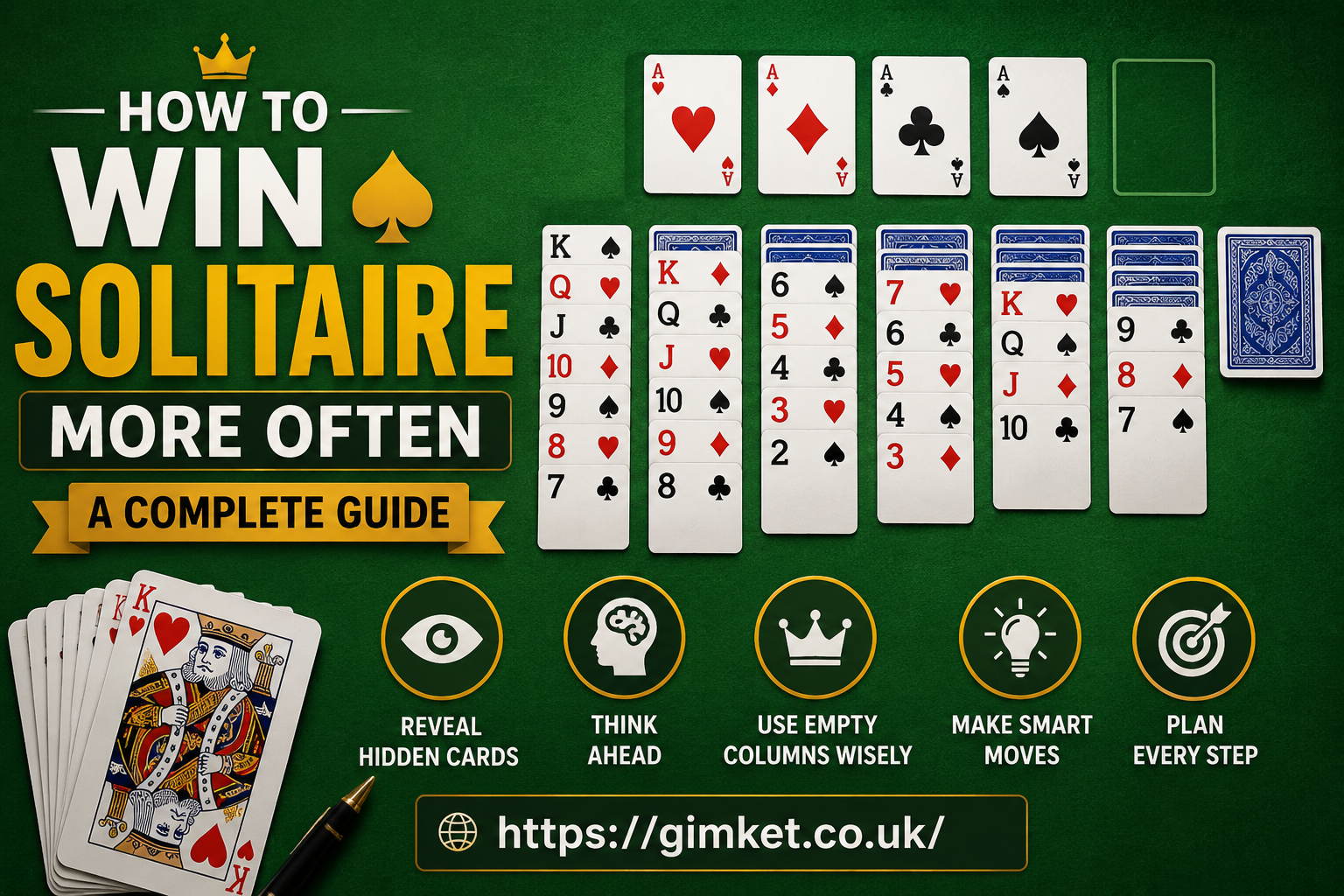
If you’ve ever wondered how to win Solitaire more consistently, you’re not alone. Solitaire is one of the world’s most popular card games because it’s easy to learn but surprisingly challenging to master. While luck plays a role in every game, skillful decision-making can significantly improve your winning percentage.
Understanding the game’s mechanics, planning several moves ahead, and avoiding common mistakes can make the difference between a frustrating loss and a satisfying victory. Whether you’re playing the classic Klondike version on your computer, smartphone, or with a physical deck of cards, the strategies remain largely the same.
What Is Solitaire?
Solitaire is a single-player card game where the objective is to move all 52 cards into four foundation piles, sorted by suit from Ace through King.
The most common version is Klondike Solitaire, where players organize cards across seven tableau columns while drawing additional cards from the stockpile.
Although not every game is winnable due to the random shuffle, many losses happen because of avoidable strategic mistakes.
Understanding the Goal
Before learning how to win Solitaire, it’s important to understand the primary objectives:
- Build foundation piles from Ace to King.
- Reveal all face-down cards.
- Organize tableau columns efficiently.
- Manage the stockpile carefully.
- Create opportunities for future moves.
Winning requires balancing short-term gains with long-term planning.
Basic Solitaire Rules
| Area | Objective |
|---|---|
| Foundation | Build each suit from Ace to King |
| Tableau | Arrange cards in descending order with alternating colors |
| Stock | Draw additional cards when no moves remain |
| Waste Pile | Temporary holding area for drawn cards |
| Empty Columns | Usually reserved for Kings or King sequences |
Understanding these rules is essential before applying advanced strategies.
How to Win Solitaire: Proven Strategies
1. Reveal Face-Down Cards First
One of the biggest priorities should always be uncovering hidden cards.
Every face-down card represents unknown possibilities. Revealing them expands your options and often opens important sequences.
For example:
Instead of immediately moving a card to the foundation, ask yourself whether another move would reveal a hidden card.
Most experienced players prioritize revealing cards over scoring quick foundation points.
2. Don’t Rush Cards to the Foundation
Many beginners immediately move every eligible card to the foundation.
This often limits flexibility.
Keeping certain low-value cards in the tableau can help create longer alternating-color sequences.
Only move cards to the foundation when you’re confident they won’t be needed later.
3. Think Several Moves Ahead
Every move changes future possibilities.
Before making any decision, consider questions like:
- Will this reveal a hidden card?
- Does this create an empty column?
- Will I block another useful sequence?
- Is there a better alternative?
Planning ahead is one of the most valuable Solitaire skills.
4. Empty Tableau Columns Wisely
An empty tableau column is extremely valuable.
It allows you to move a King or an entire King sequence, creating more flexibility.
However, don’t empty a column just because you can.
Ask whether doing so creates better opportunities or simply wastes a useful position.
5. Build Long Alternating Sequences
Long card sequences provide more mobility.
Instead of making the first legal move you notice, look for ways to build longer alternating-color stacks.
Example:
Instead of moving one red six, consider whether moving another card first creates a larger sequence that can move together.
Manage the Stockpile Carefully
The stockpile often determines whether a game becomes winnable.
Good habits include:
- Remember the order of visible waste cards.
- Avoid cycling through the deck without a plan.
- Delay unnecessary draws.
- Make every available tableau move before drawing again.
Efficient stock management improves decision-making throughout the game.
Common Mistakes That Reduce Your Winning Chances
Many players unknowingly lower their success rate.
Moving Every Ace Immediately
Although foundations are important, moving every available card immediately isn’t always the best strategy.
Ignoring Hidden Cards
Failing to prioritize hidden cards often leaves important moves unavailable.
Emptying Columns Too Early
Empty spaces are valuable resources.
Using one too soon can reduce flexibility later.
Making Automatic Moves
Experienced players rarely play on instinct.
They evaluate multiple possibilities before committing.
Best Move Priority
When multiple moves are available, this order generally works well:
- Reveal a hidden card.
- Create useful tableau sequences.
- Free an Ace or Two.
- Empty a tableau column if beneficial.
- Move cards to the foundation.
- Draw from the stockpile.
Following this priority often leads to stronger overall play.
Beginner vs Experienced Strategy
| Beginner Habit | Better Strategy |
|---|---|
| Rush foundation cards | Keep flexibility |
| Draw constantly | Exhaust tableau moves first |
| Ignore future moves | Plan several turns ahead |
| Move first legal card | Compare all possible moves |
| Empty columns immediately | Wait for meaningful opportunities |
Can Every Solitaire Game Be Won?
No.
Not every shuffled Solitaire game is mathematically solvable.
Depending on the specific rules and version being played, many games are impossible to complete regardless of skill.
However, strong strategy significantly increases your winning percentage over time.
How Long Does It Take to Improve?
Most players notice improvement after consistent practice.
Focus on:
- Recognizing common patterns.
- Planning ahead.
- Learning from losses.
- Avoiding rushed decisions.
After several dozen games, many players naturally begin making smarter choices.
Tips to Win Solitaire Faster
How to win solitaire Winning quickly requires balancing speed with careful planning.
Helpful habits include:
- Scan the entire tableau before making a move.
- Avoid unnecessary card movements.
- Memorize waste pile order.
- Reveal hidden cards as early as possible.
- Keep options open instead of committing too soon.
Speed improves naturally as your strategic thinking develops.
Practice Makes a Difference
Like chess, Sudoku, or other strategy games, Solitaire rewards experience.
The more games you play, the easier it becomes to recognize:
- Productive sequences
- Dead-end positions
- High-value moves
- Efficient card organization
Consistent practice develops intuition while reducing common mistakes.
Frequently Asked Questions
1. Is Solitaire mostly luck or skill?
Solitaire combines both. Card shuffling introduces luck, but strategic decisions have a major impact on your overall win rate.
2. What is the best first move in Solitaire?
Generally, revealing a face-down card is the strongest opening move because it increases your available options.
3. Should I always move cards to the foundation?
No. Sometimes keeping cards in the tableau provides greater flexibility for building sequences and uncovering hidden cards.
4. Why can’t I win every Solitaire game?
Some Solitaire deals are impossible to solve due to the initial card arrangement, regardless of player skill.
5. Does practice improve Solitaire performance?
Yes. Experienced players recognize patterns, avoid common mistakes, and make better long-term decisions, leading to more frequent wins.
6. What is the most common Solitaire mistake?
The most common mistake is moving cards to the foundation too early instead of maintaining flexibility within the tableau.
7. Are there different versions of Solitaire?
Yes. Popular variations include Klondike, Spider, FreeCell, Pyramid, TriPeaks, and Yukon, each with unique rules and strategies.
Conclusion
Learning how to win Solitaire is about more than making legal moves—it’s about making smart ones. While no strategy can overcome every impossible deal, thoughtful play dramatically increases your chances of success. Prioritize revealing hidden cards, plan several moves ahead, use empty tableau columns strategically, and avoid rushing cards to the foundation. With regular practice and a patient approach, you’ll develop stronger decision-making skills and enjoy winning Solitaire more often. Whether you’re a beginner or an experienced player, these proven techniques will help you play with greater confidence and consistency.