
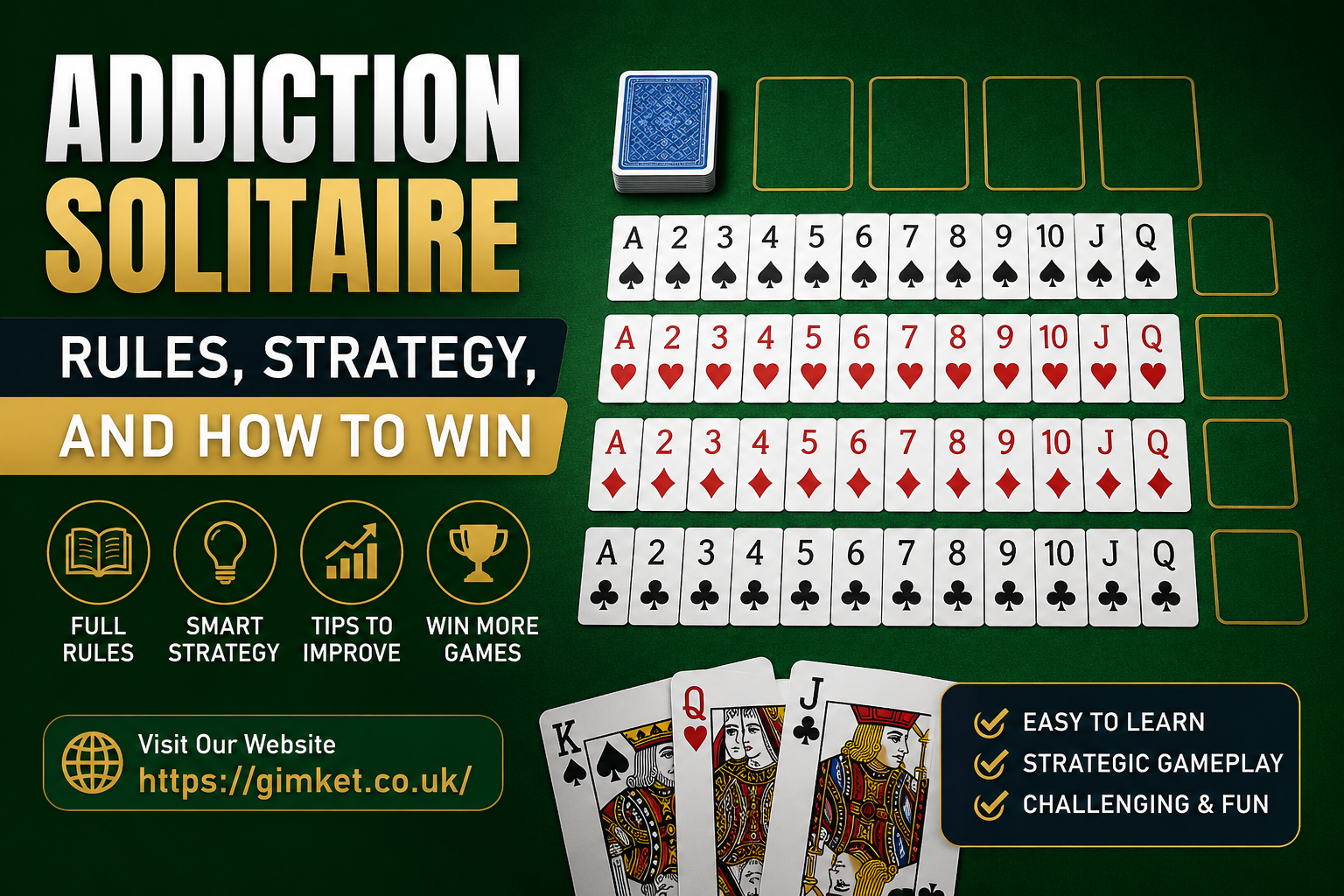
Addiction Solitaire is a unique single-player card game that blends careful planning with a bit of luck. Unlike traditional solitaire games that rely heavily on building suits or foundations, Addiction Solitaire challenges players to arrange cards in numerical order while making the best use of limited empty spaces.
The game is simple to learn but surprisingly difficult to master. Many first-time players assume success depends entirely on chance, yet experienced players know that thoughtful decisions can significantly improve their winning percentage.
What Is Addiction Solitaire?
Addiction Solitaire, sometimes called Gaps Solitaire or Addiction Patience, is a variation of solitaire played with a standard 52-card deck.
Instead of creating foundation piles, players rearrange cards directly within the tableau. The goal is to organize each row so that cards of the same suit appear in ascending order from Ace through Queen, with the final space in each row left empty.
Because every move changes future possibilities, Addiction Solitaire rewards players who think several moves ahead rather than simply reacting to the current board.
Objective of Addiction Solitaire
Your objective is to arrange all four rows so they follow this pattern:
| Position | Example |
|---|---|
| First Card | Ace |
| Second Card | 2 |
| Third Card | 3 |
| Continue… | … |
| Twelfth Card | Queen |
| Final Space | Empty |
Each row must contain cards from the same suit in the correct numerical order.
Game Setup
A standard game includes:
- One 52-card deck
- Four rows
- Thirteen spaces per row
- All Kings removed initially, leaving four empty spaces
The four empty spaces are what allow cards to move during gameplay.
Addiction Solitaire Rules
Understanding the rules is essential before developing advanced strategies.
1. Only Certain Cards Can Fill Empty Spaces
An empty space can only be filled by:
- An Ace if the empty position is at the beginning of a row.
- The next higher card of the same suit following the card immediately to the left.
For example:
If a 7 of Hearts appears immediately to the left of an empty space, only the 8 of Hearts may be moved there.
2. Kings Never Return
Kings are removed at the beginning of the game and never re-enter play.
3. Reshuffling
When no more legal moves remain:
- Correctly positioned sequences stay in place.
- Remaining cards are shuffled.
- The shuffle is redealt into the remaining open spaces.
Most versions allow three reshuffles, though some online versions offer different settings.
4. Winning the Game
You win when:
- Every row contains one suit.
- Cards appear from Ace through Queen in order.
- The final position in every row remains empty.
Understanding Movement with an Example
Imagine a row looks like this:
| Card | Card | Card | Empty |
|---|---|---|---|
| Ace♠ | 2♠ | 3♠ | □ |
Only the 4♠ may move into the empty space.
If the row instead begins with an empty space:
| Empty | 4♥ | 5♥ |
Only an Ace may occupy the first position.
These movement restrictions are what make Addiction Solitaire such an engaging puzzle.
Best Addiction Solitaire Strategies
Plan Several Moves Ahead
Avoid making the first legal move you notice.
Instead, ask yourself:
- Will this create another useful empty space?
- Does this help complete a sequence?
- Will it block future moves?
Thinking two or three turns ahead often leads to much stronger positions.
Prioritize Building Long Sequences
Longer correctly ordered sequences reduce the number of cards that need reshuffling later.
Focus on extending complete suit runs whenever possible.
Keep Important Empty Spaces Available
An empty space is your most valuable resource.
Avoid filling it immediately if waiting creates better opportunities elsewhere.
Position Aces Early
Because every row starts with an Ace, placing available Aces quickly often unlocks additional legal moves.
Avoid Blocking Progress
Sometimes placing a legal card limits future options.
Before moving a card, consider whether another move creates greater flexibility.
Common Mistakes Beginners Make
Playing Too Quickly
Many players rush through available moves.
A few extra seconds of planning can significantly improve your results.
Ignoring Suit Order
Cards must follow both:
- Numerical order
- Matching suit
A correct number with the wrong suit cannot be placed.
Wasting Empty Spaces
Every empty space offers strategic flexibility.
Using one carelessly may reduce future opportunities.
Forgetting About Reshuffles
Each reshuffle becomes less effective if too many cards remain out of position.
Aim to organize as much of the tableau as possible before reshuffling.
Skill vs. Luck
A common question is whether Addiction Solitaire is mostly luck or skill.
The answer is both—but skill plays a larger role than many players expect.
Luck influences:
- Initial card layout
- Shuffle outcomes
- Available sequences
Skill influences:
- Move selection
- Sequence planning
- Efficient use of empty spaces
- Timing of reshuffles
Experienced players consistently achieve higher win rates because they recognize patterns and avoid unnecessary mistakes.
Tips to Improve Your Winning Percentage
Try these practical habits:
- Scan the entire board before making any move.
- Build complete suit sequences whenever possible.
- Delay unnecessary moves.
- Protect useful empty spaces.
- Think beyond the immediate move.
- Learn from unsuccessful games.
- Practice regularly to recognize recurring patterns.
Even small improvements in decision-making can noticeably increase your success over time.
Addiction Solitaire Compared with Classic Solitaire
| Feature | Addiction Solitaire | Classic Klondike Solitaire |
|---|---|---|
| Foundation piles | No | Yes |
| Empty spaces matter | Very important | Occasionally |
| Main challenge | Card sequencing | Building foundations |
| Planning required | High | Moderate |
| Luck factor | Moderate | Moderate to High |
| Strategic depth | High | Moderate |
Players who enjoy puzzle-solving often find Addiction Solitaire more mentally engaging than traditional Klondike.
Why Players Enjoy Addiction Solitaire
Several factors contribute to its lasting popularity:
- Easy rules
- Challenging gameplay
- Quick rounds
- Strong replay value
- Meaningful strategic decisions
- Gradual skill improvement
Because every game presents a different layout, no two sessions feel exactly alike.
Can Every Game Be Won?
No.
Like many solitaire variants, not every deal is winnable.
Some starting layouts create unavoidable dead ends regardless of the player’s decisions.
However, skilled play increases the percentage of games that can be successfully completed.
Rather than expecting every game to be winnable, focus on making the strongest possible decisions throughout each round.
Frequently Asked Questions
1. Is Addiction Solitaire difficult to learn?
No. The basic rules are straightforward, but mastering the game’s strategy takes practice and experience.
2. How many reshuffles do you get in Addiction Solitaire?
Most versions provide three reshuffles, although some digital versions allow players to customize this setting.
3. Is Addiction Solitaire a game of skill?
Yes. While card order involves chance, strategic planning has a significant impact on your long-term success.
4. Can you undo moves in online versions?
Many digital versions include an undo feature, making it easier to experiment with different strategies.
5. What is the biggest mistake beginners make?
The most common mistake is making the first available legal move without considering how it affects future opportunities.
6. Are Addiction Solitaire and Gaps Solitaire the same game?
Yes. In many software versions and websites, the two names refer to the same solitaire variation with identical gameplay.
Conclusion
Addiction Solitaire stands out among patience games because it rewards thoughtful planning rather than quick decisions. Although luck affects the initial layout and reshuffles, experienced players know that careful sequencing, efficient use of empty spaces, and long-term planning make the biggest difference.
By understanding the rules, practicing proven strategies, and avoiding common mistakes, you’ll steadily improve your ability to recognize winning opportunities. Whether you’re playing for relaxation or aiming to increase your win rate, Addiction Solitaire offers a satisfying blend of logic, challenge, and replayability that keeps players coming back game after game.