
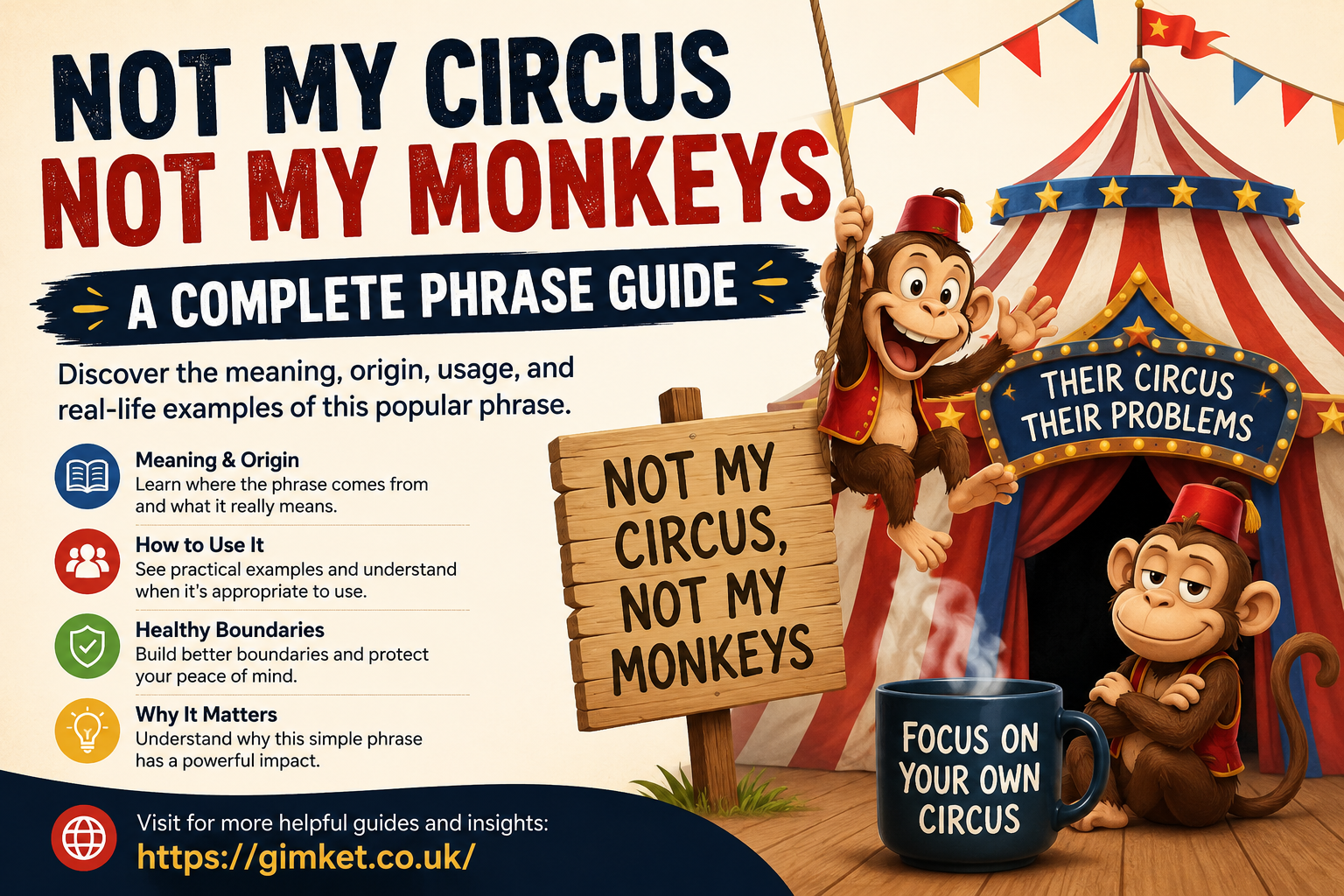
The phrase Not My Circus Not My Monkeys has become a popular way to express the idea of refusing to take responsibility for problems that do not belong to you. Whether you have seen it on social media, heard it in a workplace conversation, or come across it in a book, the saying carries a simple but powerful message about personal boundaries and emotional well-being.
Although it sounds humorous, the expression reflects an important life lesson: you do not have to solve every conflict or carry everyone else’s burdens. Learning when to step back can reduce stress, improve relationships, and help you focus on what truly matters.
In this complete guide, you’ll discover the meaning of Not My Circus Not My Monkeys, where the phrase comes from, how to use it correctly, examples from everyday life, common misunderstandings, and why it continues to resonate with people around the world.
Key Takeaways
- Not My Circus Not My Monkeys means someone else’s problems are not your responsibility.
- The phrase originates from a traditional Polish proverb.
- It encourages healthy personal and professional boundaries.
- It can be used in both casual and workplace conversations when appropriate.
- The saying promotes emotional balance rather than avoiding responsibility.
Main Article
What Does “Not My Circus Not My Monkeys” Mean?
The expression Not My Circus Not My Monkeys means that a particular problem, conflict, or responsibility belongs to someone else—not you.
In simple terms, it communicates:
- This situation is not my responsibility.
- I am choosing not to become involved.
- The people responsible should solve their own problems.
The phrase is often used with humor, but its underlying message is serious. It reminds people that constantly taking on other people’s stress can become emotionally exhausting.
For example:
- Two coworkers argue over a project that doesn’t involve you.
- Friends expect you to settle a disagreement that isn’t yours.
- Family members pull you into ongoing conflicts.
In these situations, saying “Not my circus, not my monkeys” politely acknowledges that the issue belongs to someone else.
The Origin of the Phrase
The expression is widely believed to come from the Polish proverb:
“Nie mój cyrk, nie moje małpy.”
The literal English translation is:
“Not my circus, not my monkeys.”
In Polish culture, the proverb has long been used to remind people not to interfere in matters that do not concern them.
Over time, the phrase spread internationally through books, blogs, travel experiences, and social media. Today, it is commonly used in English-speaking countries while retaining its original imagery.
The unusual combination of a circus and monkeys makes the proverb memorable and easy to recognize.
Why Is the Phrase So Popular?
The popularity of Not My Circus Not My Monkeys comes from its universal message.
Modern life often involves:
- Workplace stress
- Family disagreements
- Social drama
- Online arguments
- Community conflicts
Many people feel pressure to solve everyone else’s problems.
This phrase reminds us that protecting our own peace is sometimes the healthier choice.
It also captures an important truth:
You cannot control everything—or everyone.
Healthy Boundaries and Personal Responsibility
One reason psychologists and wellness experts often discuss ideas similar to this proverb is because healthy boundaries improve emotional well-being.
Healthy boundaries mean knowing:
- What you are responsible for
- What belongs to someone else
- When helping becomes unhealthy
- When saying “no” is appropriate
Using the mindset behind Not My Circus Not My Monkeys does not mean becoming selfish.
Instead, it means recognizing the difference between:
| Healthy Support | Unhealthy Responsibility |
|---|---|
| Offering advice when asked | Solving every problem |
| Listening with empathy | Becoming emotionally overwhelmed |
| Helping voluntarily | Feeling obligated to fix everything |
| Respecting others’ choices | Taking responsibility for their decisions |
When Should You Use the Phrase?
The expression works best in informal situations.
Common examples include:
Workplace
Two departments disagree over a decision.
You are not involved.
You might think:
“Not my circus, not my monkeys.”
This helps remind yourself to stay focused on your own responsibilities.
Family Drama
Relatives argue over old disagreements.
Instead of choosing sides unnecessarily, you decide not to become involved.
Social Media
Online debates often become emotional.
Rather than joining every argument, you recognize that not every discussion requires your participation.
Friendships
Two friends disagree and both expect you to mediate.
Sometimes neutrality is the healthiest choice.
When You Should Avoid Using It
Although the phrase is useful, there are situations where it should not be used.
For example:
- Emergencies
- Child safety
- Workplace duties assigned to you
- Legal responsibilities
- Situations where someone genuinely needs immediate help
Avoid using the phrase to ignore responsibilities that actually belong to you.
The proverb is about avoiding unnecessary involvement—not avoiding accountability.
Examples in Everyday Conversations
Here are several examples.
Example 1
Coworker:
“Marketing and Sales are arguing again.”
Response:
“I’m staying out of it. Not my circus, not my monkeys.”
Example 2
Friend:
“Did you hear about their relationship problems?”
Response:
“I hope they work it out, but it’s not my circus, not my monkeys.”
Example 3
Family member:
“Can you settle this disagreement?”
Response:
“I’d rather not get involved unless both of you ask me.”
In some situations, saying the full phrase aloud may sound humorous, while in others it is better kept as a personal reminder.
Similar Expressions
English contains several sayings with similar meanings.
| Expression | Meaning |
|---|---|
| Not my problem | I’m not responsible. |
| Stay in your lane | Focus on your own responsibilities. |
| Mind your own business | Avoid interfering unnecessarily. |
| Let them figure it out | Others should solve their own issue. |
| That’s on them | Responsibility belongs to someone else. |
Although similar, Not My Circus Not My Monkeys is often considered more memorable because of its vivid imagery.
Common Misunderstandings
Some people believe the phrase encourages people to stop helping others.
That is not its true meaning.
Instead, it encourages thoughtful decision-making.
Helping someone is generous.
Feeling responsible for everyone’s problems is unhealthy.
The phrase promotes balance.
You can still:
- Support friends.
- Care about family.
- Volunteer in your community.
- Offer advice.
The difference is that you choose to help rather than feeling forced.
Why the Phrase Still Matters Today
Today’s fast-paced world exposes people to countless opinions, conflicts, and responsibilities.
News, social media, messaging apps, and workplace communication mean we constantly hear about other people’s problems.
Without clear boundaries, this can lead to:
- Stress
- Anxiety
- Burnout
- Emotional exhaustion
The message behind Not My Circus Not My Monkeys reminds us that protecting our mental energy is important.
It encourages us to invest our time where we can make a genuine difference instead of becoming overwhelmed by issues beyond our control.
Practical Ways to Apply the Mindset
If you want to embrace the wisdom behind this proverb, consider these habits:
- Ask yourself whether the problem is actually yours to solve.
- Avoid jumping into conflicts unless your involvement is necessary.
- Offer support without taking ownership of someone else’s choices.
- Focus your energy on your own goals and responsibilities.
- Practice saying “no” respectfully when appropriate.
- Remember that caring about others does not require fixing everything.
These habits help create healthier relationships while reducing unnecessary stress.
Why the Phrase Continues to Resonate
The lasting popularity of Not My Circus Not My Monkeys comes from its simplicity.
It combines humor with practical wisdom.
People remember it because the image of a circus full of mischievous monkeys instantly illustrates chaos—and reminds us that not every chaotic situation belongs to us.
Whether used in personal life, friendships, or the workplace, the proverb encourages thoughtful choices, emotional resilience, and respect for personal boundaries.
Frequently Asked Questions
1. What does “Not My Circus Not My Monkeys” mean?
It means a problem or conflict belongs to someone else, and you are not responsible for solving it.
2. Where did the phrase originate?
The expression comes from the Polish proverb “Nie mój cyrk, nie moje małpy,” which carries the same meaning.
3. Is the phrase considered rude?
Not necessarily. It depends on the context and tone. It is often used humorously or as a personal reminder rather than a direct statement to someone else.
4. Can I use it in a professional setting?
Yes, but use discretion. It is usually better suited to informal conversations or personal reflection than formal business communication.
5. Does the phrase encourage avoiding responsibility?
No. It encourages recognizing which responsibilities genuinely belong to you while respecting healthy boundaries.
6. Why has the phrase become so popular?
Its memorable imagery, practical wisdom, and relevance to modern life have made it widely shared in conversations, books, and social media.
Conclusion
Not My Circus Not My Monkeys is much more than a humorous saying. It is a reminder that healthy boundaries are essential for emotional well-being, productive relationships, and peace of mind. While kindness and support remain valuable, taking responsibility for every conflict or problem around you can quickly become overwhelming.
Understanding the meaning, origin, and proper use of this well-known proverb helps you apply it wisely in everyday life. Whether you’re navigating workplace disagreements, family tensions, or social situations, remembering that not every problem is yours to solve can lead to healthier decisions and less unnecessary stress. By embracing the lesson behind this timeless phrase, you can focus your energy where it truly matters while still showing compassion and respect for others.