
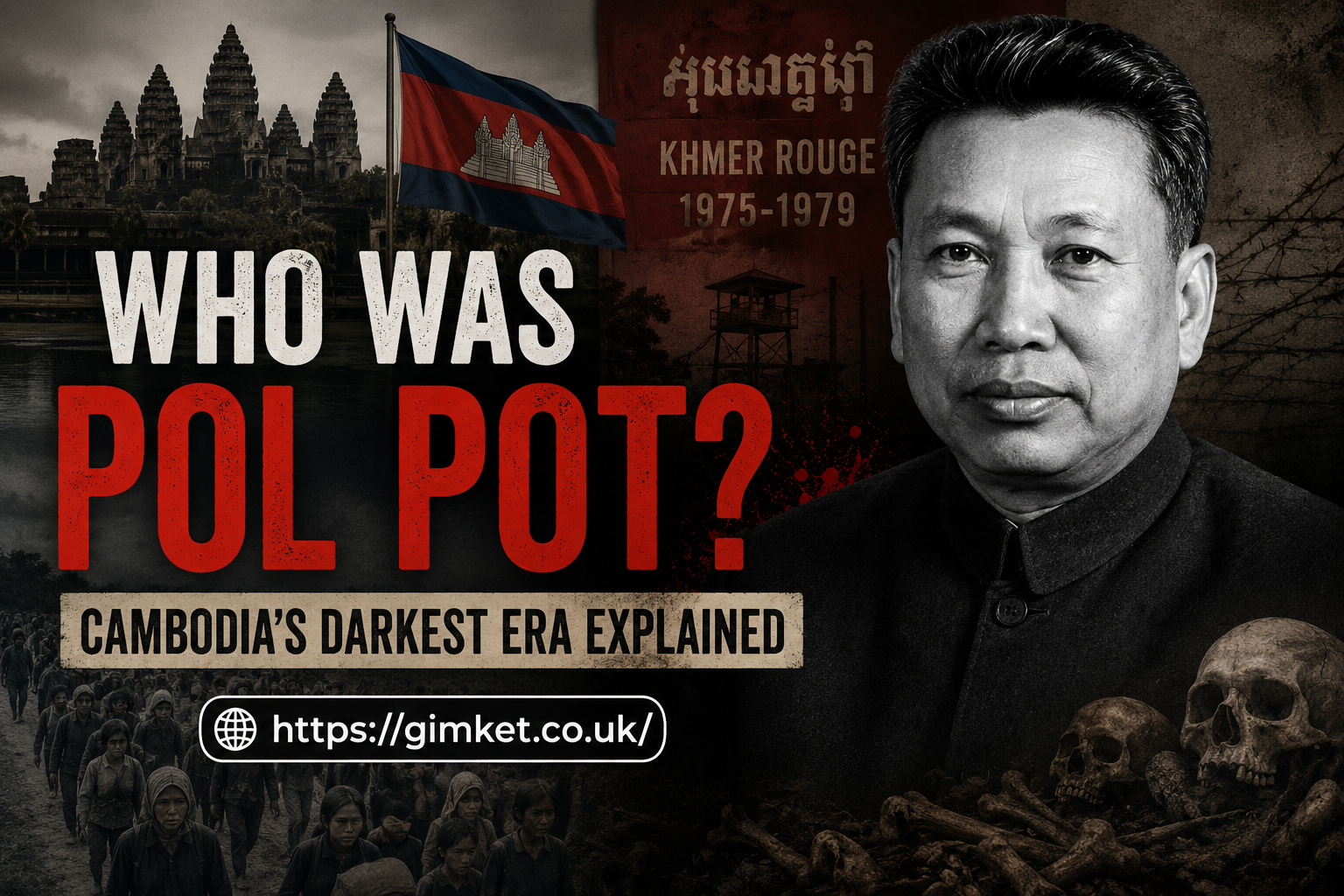
Few figures in modern history are associated with such widespread suffering and destruction as Pol Pot. As the leader of the Khmer Rouge movement in Cambodia, he oversaw one of the most devastating periods of the 20th century, during which millions of people suffered from forced labor, starvation, disease, and mass executions.
Understanding Pol Pot is important not only because of the events that occurred under his leadership but also because his rise shows how extreme political ideologies, propaganda, and authoritarian control can transform an entire nation.
Biography Table
| Category | Details |
|---|---|
| Full Name | Saloth Sar (commonly known as Pol Pot) |
| Date of Birth | May 19, 1925 |
| Age | Died at age 72 |
| Birthplace | Prek Sbauv, Cambodia |
| Nationality | Cambodian |
| Profession | Political leader, revolutionary, communist figure |
| Education | Studied in Cambodia and later in France |
| Years Active | 1950s–1990s |
| Known For | Leadership of the Khmer Rouge and rule of Democratic Kampuchea |
| Major Achievements | Led the Khmer Rouge movement to power in Cambodia (historically significant, though associated with mass atrocities) |
Who Was Pol Pot?
Pol Pot was the political leader of the Khmer Rouge, the communist organization that controlled Cambodia from 1975 to 1979. Born as Saloth Sar, he later adopted the name Pol Pot while becoming involved in revolutionary politics.
His vision was based on creating a completely transformed Cambodian society built around extreme rural communism. The Khmer Rouge believed Cambodia could become a self-sufficient agricultural nation by removing influences they considered harmful, including modern education, cities, religion, and foreign ideas.
However, the policies introduced under Pol Pot’s leadership caused enormous human suffering. His government forced millions of people into agricultural labor, destroyed social structures, and carried out violent campaigns against perceived enemies.
Early Life and Education of Pol Pot
Pol Pot was born into a relatively comfortable farming family in Cambodia during the period when the country was under French colonial influence. His birth name was Saloth Sar.
As a young man, he moved to Phnom Penh, where he received education that exposed him to both Cambodian culture and French colonial systems. Later, he traveled to France to study radio electronics.
While living in Paris during the late 1940s, Pol Pot became involved with communist political groups. He was influenced by Marxist ideas and revolutionary movements that were spreading internationally at the time.
After returning to Cambodia, he joined underground communist organizations and gradually rose through the ranks of the Cambodian communist movement.
The Rise of Pol Pot and the Khmer Rouge
The Khmer Rouge emerged from Cambodia’s communist movement during a period of political instability. Cambodia experienced significant turmoil due to regional conflicts, including the Vietnam War and internal struggles between different political groups.
During the early 1970s, the Khmer Rouge gained support among some rural communities by presenting themselves as a movement that would end corruption and restore Cambodian independence.
In 1975, the Khmer Rouge captured Phnom Penh and took control of Cambodia. Pol Pot became the central figure behind the new government, officially known as Democratic Kampuchea.
The new leadership immediately began implementing radical policies designed to completely reshape Cambodian society.
The Khmer Rouge Regime Under Pol Pot
The Khmer Rouge government attempted to create what it called a “Year Zero” society. This meant starting Cambodia over from the beginning by removing previous social, economic, and cultural systems.
Major policies included:
- Abolishing money and private property
- Closing schools and universities
- Eliminating traditional religious practices
- Forcing urban residents into rural farming communities
- Creating collective agricultural systems
- Removing political opponents and intellectuals
The government believed that educated people, professionals, and those connected to previous governments represented threats to its revolution.
This led to widespread persecution of teachers, doctors, government workers, religious figures, and many ordinary citizens.
Life Under the Khmer Rouge
For many Cambodians, life under Pol Pot’s rule became extremely difficult. Families were separated, communities were reorganized, and people were forced to work long hours under harsh conditions.
Workers often received inadequate food while being required to meet unrealistic agricultural targets. Malnutrition and disease became widespread.
People were punished for small acts of resistance or for being considered enemies of the revolution. Even having an education, speaking a foreign language, or wearing glasses could sometimes lead to suspicion.
The regime created a climate of fear where citizens had little freedom and few ways to challenge government decisions.
The Cambodian Genocide
The period from 1975 to 1979 is widely recognized as one of the darkest chapters in Cambodian history. Under Pol Pot’s leadership, mass killings and severe human rights abuses occurred across the country.
Many victims were executed at locations that later became known as “killing fields.” Others died from starvation, exhaustion, and disease caused by forced labor policies.
Historians estimate that approximately 1.5 to 2 million people died during the Khmer Rouge period, although exact numbers remain debated.
Victims included:
- Political opponents
- Ethnic minorities
- Religious communities
- Intellectuals and professionals
- Ordinary Cambodian citizens accused of disloyalty
The Fall of Pol Pot’s Government
Pol Pot’s rule ended in 1979 when Vietnam invaded Cambodia and removed the Khmer Rouge from power.
Following the invasion, Pol Pot and remaining Khmer Rouge forces retreated to areas near the Thai border. Despite losing control of the country, the Khmer Rouge continued as an armed movement for many years.
International politics during the Cold War allowed the group to maintain some influence, even after its government had collapsed.
Later Years and Death of Pol Pot
During his later years, Pol Pot lived in remote areas while remaining connected to Khmer Rouge supporters. The movement gradually weakened as Cambodia moved toward peace and political rebuilding.
In 1997, Pol Pot was placed under house arrest by members of his own movement after internal conflicts. He died on April 15, 1998.
Although he never faced a full international trial, his actions remain the subject of historical research, survivor accounts, and discussions about justice and accountability.
Historical Impact and Legacy of Pol Pot
The legacy of Pol Pot remains deeply connected to discussions about genocide, authoritarianism, and human rights.
His rule changed Cambodia permanently. The country lost a large portion of its population, many cultural traditions were disrupted, and entire communities experienced trauma that continues across generations.
The Cambodian experience under the Khmer Rouge provides important lessons about:
- The dangers of extreme political ideologies
- The importance of protecting human rights
- The risks of unchecked government power
- The need for historical education and remembrance
Today, museums, memorial sites, and survivor testimonies help preserve the memory of those affected by the Khmer Rouge period.
Why Pol Pot Remains Historically Important
Studying Pol Pot is not about understanding only one individual. It is about examining how political movements can become destructive when leaders remove democratic limits and use violence to achieve ideological goals.
His history is studied by historians, educators, and human rights organizations because it demonstrates how quickly societies can change under authoritarian control.
Understanding this period helps future generations recognize warning signs of oppression and appreciate the importance of justice, freedom, and human dignity.
Frequently Asked Questions
Who was Pol Pot?
Pol Pot was the leader of the Khmer Rouge, a communist movement that ruled Cambodia from 1975 to 1979. His government was responsible for widespread human suffering and mass deaths.
What was Pol Pot’s real name?
Pol Pot’s real name was Saloth Sar. He adopted the name Pol Pot while becoming a prominent figure in Cambodia’s communist movement.
What was the Khmer Rouge?
The Khmer Rouge was a communist revolutionary group that controlled Cambodia between 1975 and 1979. It attempted to create an extreme agricultural society through radical social and economic changes.
How many people died under Pol Pot’s rule?
Historians estimate that around 1.5 to 2 million people died during the Khmer Rouge period due to executions, starvation, forced labor, and disease.
Why did Pol Pot target educated people?
The Khmer Rouge viewed educated professionals and people connected to previous systems as threats to their revolutionary goals. Many teachers, doctors, and intellectuals were persecuted.
How did Pol Pot lose power?
Pol Pot lost power in 1979 after Vietnam invaded Cambodia and removed the Khmer Rouge government from Phnom Penh.
When did Pol Pot die?
Pol Pot died on April 15, 1998, while living in a remote area of Cambodia.
Conclusion
Pol Pot remains one of the most controversial and tragic figures in modern history. His leadership of the Khmer Rouge transformed Cambodia through extreme policies that caused unimaginable suffering and loss of life.
The story of Pol Pot is a reminder of the dangers of authoritarian power, intolerance, and political extremism. By studying Cambodia’s history during this period, people can better understand the importance of human rights, accountability, and protecting societies from destructive ideologies.