
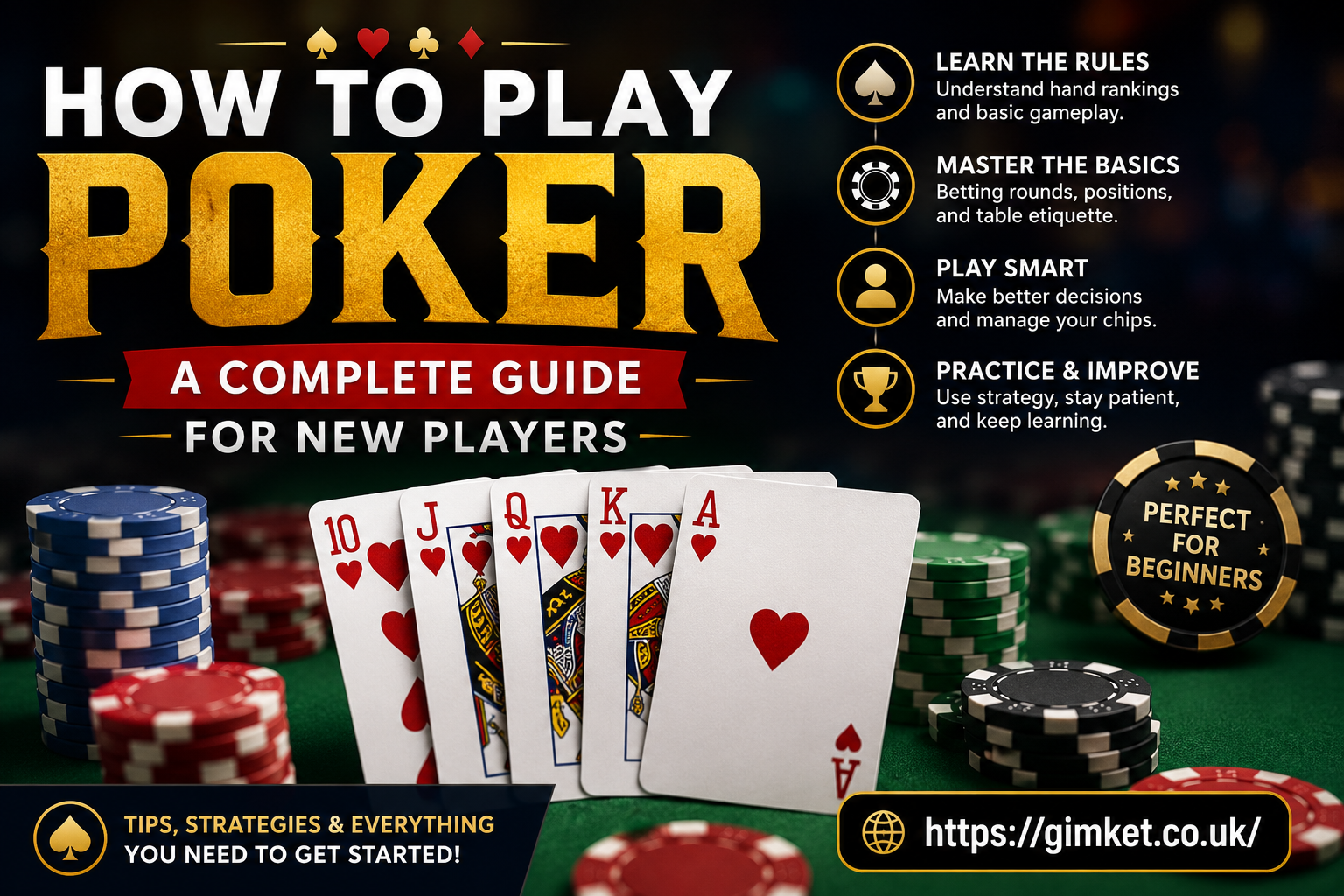
Poker is one of the most popular card games in the world, combining strategy, psychology, decision-making, and probability. While the basic rules are easy to learn, becoming a skilled player requires understanding hand rankings, betting strategies, and how to read different situations at the table.
For new players, learning Poker can feel overwhelming at first because the game includes many terms, variations, and strategic choices. However, with the right foundation, anyone can understand the basics and start playing confidently.
This complete guide explains how to play Poker, from the rules and card rankings to betting rounds, beginner strategies, common mistakes, and practical tips for improving your game. Whether you want to play casually with friends or develop stronger skills, this guide will help you build a solid understanding of the game.
What Is Poker?
Poker is a family of card games where players compete against each other using a combination of cards, betting decisions, and strategic thinking. Unlike many traditional card games, Poker is not only about having the strongest cards. Players can also win by making smart decisions and applying pressure through betting.
The goal of Poker depends on the specific variation being played, but the general objective is to either:
- Create the best possible hand at the end of the game.
- Make opponents fold before reaching the final showdown.
The game is usually played with a standard 52-card deck, and players place bets using chips that represent money or points.
Understanding Poker Hand Rankings
Before learning advanced strategies, every beginner must understand Poker hand rankings. These rankings determine which player wins when hands are compared.
| Rank | Hand | Description |
|---|---|---|
| 1 | Royal Flush | Ace-high straight flush, the strongest possible hand |
| 2 | Straight Flush | Five consecutive cards of the same suit |
| 3 | Four of a Kind | Four cards with the same value |
| 4 | Full House | Three of a kind combined with a pair |
| 5 | Flush | Five cards of the same suit |
| 6 | Straight | Five consecutive cards of different suits |
| 7 | Three of a Kind | Three cards with the same value |
| 8 | Two Pair | Two different pairs |
| 9 | One Pair | Two cards with the same value |
| 10 | High Card | The highest single card when no combination is made |
Knowing these rankings allows players to quickly evaluate their chances during a game.
How to Play Poker Step by Step
Most beginners start with Texas Hold’em, the most widely played Poker format. The game follows a simple structure.
Learn the Basic Setup
A typical Texas Hold’em game includes:
- 2 to 10 players
- A dealer position
- Small blind and big blind bets
- A standard 52-card deck
- Betting rounds
The dealer position rotates after every hand, ensuring that each player takes different positions around the table.
Receive Your Starting Cards
Each player receives two private cards known as hole cards. These cards are only visible to the player holding them.
Players must combine their hole cards with five shared community cards placed in the center of the table.
The objective is to create the strongest five-card Poker hand.
Understand the Betting Rounds
Texas Hold’em includes four main betting rounds:
Pre-Flop
The first betting round happens after players receive their two private cards.
Players decide whether to:
- Fold
- Call
- Raise
Flop
The dealer places three community cards face-up on the table.
Players analyze how these cards connect with their private cards and decide their next move.
Turn
A fourth community card is added.
At this stage, players have more information and must consider possible winning hands.
River
The fifth and final community card is revealed.
Players make their final decisions before the showdown.
The Showdown
If multiple players remain after the final betting round, they reveal their cards.
The player with the strongest five-card hand wins the pot.
However, Poker is unique because players can win without showing their cards. If all opponents fold before the showdown, the remaining player wins automatically.
Popular Types of Poker Games
Although Texas Hold’em is the most recognized version, several other Poker variations are popular worldwide.
| Poker Variation | Main Difference |
|---|---|
| Texas Hold’em | Two private cards and five community cards |
| Omaha | Players receive four private cards and use specific combinations |
| Seven-Card Stud | No community cards; players receive multiple personal cards |
| Five-Card Draw | Players can replace cards to improve their hand |
For beginners, Texas Hold’em is usually the easiest variation to learn because the rules are straightforward and widely used.
Essential Poker Strategies for Beginners
Learning the rules is only the beginning. Strong Poker players make better decisions by understanding strategy.
Play Fewer but Stronger Starting Hands
A common beginner mistake is playing too many hands.
Not every pair of cards is worth continuing with. Good starting hands often include:
- High pairs such as Aces, Kings, and Queens
- Strong combinations like Ace-King
- Connected cards that can create straights
Patience is one of the most important skills in Poker.
Understand Your Position
Your position at the table affects your decision-making.
Players who act later have an advantage because they can see what other players do first.
Positions are generally divided into:
- Early position
- Middle position
- Late position
- Dealer position
A player on the dealer button often has the strongest position because they act last after the flop.
Learn When to Fold
Many new players believe folding means losing. In reality, folding is an important part of successful Poker.
Experienced players save chips by avoiding weak situations.
A good player understands that protecting their bankroll is more important than winning every hand.
Manage Your Betting Decisions
Every bet should have a purpose.
Players commonly use different betting actions:
| Action | Meaning |
|---|---|
| Check | Pass the action without betting |
| Bet | Place chips into the pot |
| Call | Match another player’s bet |
| Raise | Increase the current bet |
| Fold | Give up the hand |
Good Poker players consider their cards, opponents, position, and possible outcomes before making decisions.
Common Poker Mistakes Beginners Should Avoid
New players often improve faster by recognizing mistakes early.
Playing Too Many Hands
Beginners frequently stay involved with weak cards because they want to participate more often.
Quality decisions are usually more valuable than frequent action.
Ignoring Opponent Behavior
Poker involves more than your own cards.
Pay attention to:
- Betting patterns
- Timing
- Aggression levels
- Changes in behavior
Understanding opponents helps you make better decisions.
Chasing Every Draw
A possible straight or flush can be tempting, but not every draw is worth pursuing.
Consider whether the potential reward justifies the cost of continuing.
Letting Emotions Control Decisions
Poker requires discipline.
Frustration after losing a hand can lead to poor decisions, often called “tilt.” Staying calm helps maintain better judgment.
Bankroll Management Basics
Responsible bankroll management is an important part of long-term Poker success.
Beginners should:
- Play at stakes they can comfortably afford.
- Avoid risking too much on a single game.
- Track results to understand improvement.
- Focus on learning rather than only winning.
Managing your bankroll allows you to gain experience without unnecessary financial pressure.
How Beginners Can Improve Their Poker Skills
Improvement comes from studying and practice.
Useful ways to develop your game include:
- Reviewing previous hands.
- Learning basic probabilities.
- Studying successful strategies.
- Practicing decision-making.
- Playing against different skill levels.
Many experienced players improve by analyzing their choices after each session and identifying areas for growth.
Frequently Asked Questions
What is the easiest Poker game for beginners?
Texas Hold’em is usually the easiest Poker variation for beginners because it has simple rules, widespread popularity, and many learning resources.
How many cards do you get in Poker?
In Texas Hold’em, each player receives two private cards. Five community cards are then placed on the table for all players to use.
What is the best hand in Poker?
The strongest possible hand in Poker is a Royal Flush, which consists of Ace, King, Queen, Jack, and Ten of the same suit.
Can you win Poker without the best cards?
Yes. Players can win by making opponents fold through strategic betting, even if they do not have the strongest hand.
How long does it take to learn Poker?
The basic rules can be learned quickly, but developing strong strategy and decision-making skills requires regular practice and study.
Is Poker based on luck or skill?
Poker includes an element of luck because cards are random, but long-term success depends heavily on strategy, probability, psychology, and decision-making.
What should beginners learn first in Poker?
Beginners should first learn hand rankings, betting rules, starting hand selection, and the importance of position.
Conclusion
Learning Poker is an exciting journey that combines mathematics, strategy, psychology, and patience. While anyone can understand the basic rules quickly, becoming a better player requires practice, discipline, and thoughtful decision-making.
New players should focus on mastering the fundamentals: knowing hand rankings, understanding betting rounds, choosing strong starting hands, and learning when to fold. Building these habits creates a strong foundation for future improvement.
Whether you are playing casually with friends or developing serious skills, the key to success in Poker is making smarter decisions one hand at a time. With consistent learning and experience, beginners can become more confident and strategic players.