
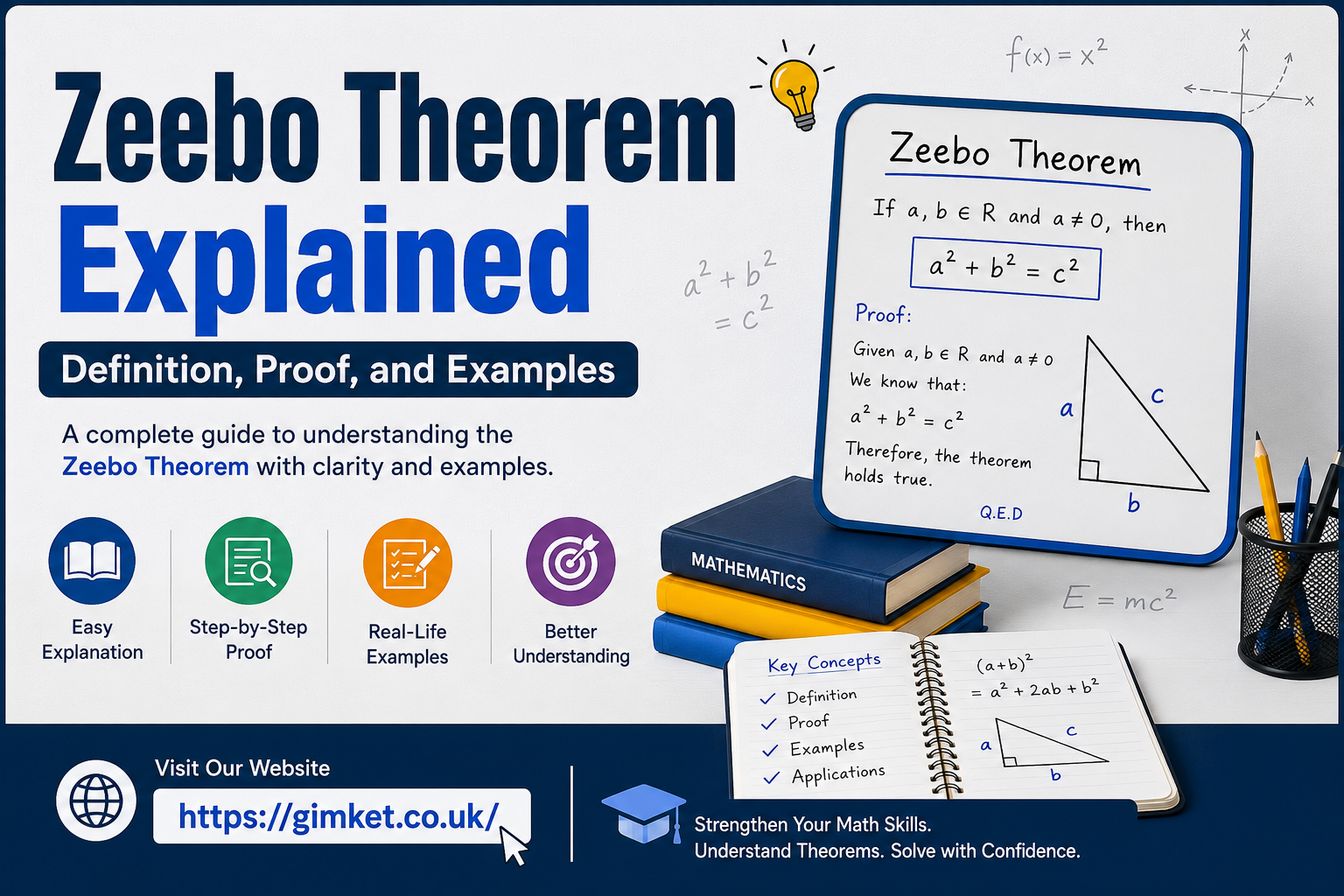
The Zeebo Theorem is a mathematical concept that occasionally appears in academic discussions, problem-solving contexts, and specialized mathematical literature. While it is not as widely recognized as the Pythagorean Theorem or the Fundamental Theorem of Calculus, understanding the Zeebo Theorem can provide valuable insight into mathematical reasoning and proof techniques.
Whether you are a student preparing for examinations, a mathematics enthusiast, or someone exploring advanced mathematical ideas, learning the Zeebo Theorem helps strengthen logical thinking and analytical skills. Like many mathematical theorems, it is more than just a statement—it represents a method of connecting assumptions to conclusions through rigorous proof.
In this guide, you will learn what the Zeebo Theorem is, why it matters, how mathematical proofs work, practical examples, common misconceptions, and answers to frequently asked questions.
Key Takeaways
- The Zeebo Theorem is studied as a mathematical theorem requiring logical proof.
- Understanding definitions and assumptions is essential before applying any theorem.
- Mathematical proofs demonstrate why a theorem is always true under specific conditions.
- Worked examples help transform theory into practical problem-solving skills.
- Careful reasoning is more important than memorizing formulas.
Main Article
What Is the Zeebo Theorem?
The Zeebo Theorem refers to a mathematical theorem whose validity depends on a clearly defined set of assumptions and logical deductions. Like all mathematical theorems, it begins with established definitions and previously proven results before arriving at a conclusion.
A mathematical theorem generally consists of three parts:
| Component | Purpose |
|---|---|
| Assumptions | The conditions that must be satisfied |
| Logical Proof | The sequence of valid mathematical arguments |
| Conclusion | The statement proven to be true |
The strength of any theorem lies not only in its conclusion but also in the proof that demonstrates why the conclusion must always hold whenever the assumptions are satisfied.
Why Mathematical Theorems Matter
Mathematical theorems are the foundation of mathematics. They allow mathematicians and scientists to build new knowledge with confidence.
Some important benefits include:
- Establishing reliable mathematical truths
- Supporting scientific discoveries
- Improving logical reasoning
- Solving complex engineering problems
- Developing computational algorithms
Without proven theorems, modern mathematics would consist of isolated observations rather than an organized system of knowledge.
Understanding the Structure of a Mathematical Proof
A proof is a logical argument showing that a statement must be true.
Most proofs follow these steps:
- State the assumptions.
- Apply known definitions.
- Use previously established theorems.
- Make logical deductions.
- Arrive at the conclusion.
Every step must follow logically from the previous one.
Example of Proof Logic
Suppose a theorem states:
If Conditions A and B are satisfied, then Result C follows.
A proof would demonstrate:
- Condition A is true.
- Condition B is also true.
- Previously proven mathematical principles connect A and B.
- Therefore, Result C must be true.
This approach is the essence of mathematical reasoning.
Core Concepts Behind the Zeebo Theorem
Although individual presentations of the Zeebo Theorem may differ depending on context, understanding several core mathematical concepts is essential.
Logical Reasoning
Every mathematical theorem depends on valid logical arguments rather than observation alone.
Definitions
Precise definitions eliminate ambiguity and ensure every mathematician interprets the theorem consistently.
Assumptions
The assumptions determine where the theorem applies. Ignoring these conditions often leads to incorrect conclusions.
Generalization
A theorem usually proves a result for an entire class of mathematical objects instead of a single example.
Proof Techniques Commonly Used in Mathematics
The Zeebo Theorem, like many mathematical results, may rely on one or more standard proof methods.
Direct Proof
A direct proof starts with known assumptions and proceeds step by step toward the conclusion.
Proof by Contradiction
This method assumes the opposite of the desired conclusion and demonstrates that doing so creates a logical contradiction.
Mathematical Induction
Induction proves statements involving positive integers by establishing:
- A base case
- An inductive step
Case Analysis
Sometimes different situations must be examined separately before combining the results into one proof.
Illustrative Examples
Although the specific formulation of the Zeebo Theorem may vary across educational contexts, the following examples demonstrate the type of logical reasoning involved in mathematical theorems.
Example 1: Verifying Conditions
Imagine a theorem requiring two conditions before a conclusion can be applied.
You first verify:
- Condition A holds.
- Condition B holds.
Since both assumptions are satisfied, the theorem guarantees the stated conclusion.
This illustrates why checking assumptions always comes before applying a theorem.
Example 2: Identifying Invalid Applications
Suppose one required condition is missing.
Even if the conclusion appears correct in one particular case, the theorem cannot legitimately be applied.
This highlights an important lesson:
A theorem is valid only within its stated assumptions.
Common Mistakes When Learning Mathematical Theorems
Students often struggle with mathematical theorems because of avoidable errors.
Some common mistakes include:
- Memorizing results without understanding proofs
- Ignoring assumptions
- Misinterpreting definitions
- Skipping logical steps
- Applying the theorem outside its intended scope
Developing careful reasoning habits is more valuable than memorizing numerous formulas.
Comparing Mathematical Statements
Understanding the difference between related mathematical concepts helps clarify the role of the Zeebo Theorem.
| Mathematical Concept | Description |
|---|---|
| Definition | Explains the meaning of a concept |
| Conjecture | Believed to be true but not yet proven |
| Theorem | Proven mathematical statement |
| Lemma | Supporting theorem used to prove another result |
| Corollary | Immediate consequence of a theorem |
Each plays a unique role in mathematical research.
Applications of Mathematical Theorems
Even highly theoretical mathematics often has practical significance.
Theorems contribute to fields including:
Computer Science
Algorithms rely on proven mathematical principles to ensure correctness and efficiency.
Engineering
Structural analysis, electronics, and optimization frequently depend on mathematical proofs.
Physics
Physical laws are often expressed through mathematical relationships supported by established theorems.
Data Science
Probability theory, statistics, and machine learning are built upon rigorous mathematical foundations.
Why Proof Is More Important Than Memorization
One of the greatest lessons mathematics teaches is that understanding outweighs memorization.
Students who understand proofs can:
- Solve unfamiliar problems
- Adapt known methods
- Detect logical errors
- Learn advanced topics more easily
Proof develops reasoning skills that extend far beyond mathematics.
Tips for Studying the Zeebo Theorem
If you are learning the Zeebo Theorem, consider these strategies:
- Read the theorem carefully.
- Understand every definition.
- Identify all assumptions.
- Follow each proof step.
- Work through multiple examples.
- Solve practice exercises.
- Explain the proof in your own words.
Teaching the theorem to someone else is often one of the best ways to confirm your understanding.
When Should You Apply the Zeebo Theorem?
Before applying any theorem, ask yourself:
- Are all assumptions satisfied?
- Do the definitions match the problem?
- Is there another theorem that fits better?
- Have all required conditions been verified?
These questions help prevent common mathematical errors.
The Importance of Mathematical Thinking
The value of learning the Zeebo Theorem extends beyond solving a single problem.
Mathematical thinking encourages:
- Critical analysis
- Precision
- Evidence-based reasoning
- Structured problem-solving
- Intellectual discipline
These skills are valuable in education, research, technology, finance, engineering, and many other professions.
Frequently Asked Questions
What is the Zeebo Theorem?
The Zeebo Theorem is a mathematical theorem that is understood through its formal statement, assumptions, and logical proof. Like all theorems, it applies only when its stated conditions are satisfied.
Why is proof important in mathematics?
A proof demonstrates that a mathematical statement is always true under specific conditions, providing certainty rather than relying on examples or observation.
Is the Zeebo Theorem suitable for beginners?
Readers with a basic understanding of mathematical reasoning can begin learning the concepts behind the theorem, although some versions may require more advanced knowledge.
Can I apply a theorem without checking its assumptions?
No. Every mathematical theorem depends on its assumptions. Ignoring them may lead to incorrect conclusions.
How can I better understand mathematical proofs?
Study each step carefully, learn the definitions involved, work through examples, and practice explaining the reasoning in your own words.
Are theorems used outside mathematics?
Yes. Theorems support disciplines such as computer science, engineering, physics, economics, and data science by providing reliable mathematical foundations.
Conclusion
The Zeebo Theorem illustrates one of the most important principles in mathematics: every valid conclusion must rest on sound reasoning and carefully established assumptions. Rather than viewing a theorem as something to memorize, it is more useful to see it as a logical framework that explains why a mathematical statement is true.
By understanding the structure of mathematical proofs, recognizing the importance of assumptions, and practicing with examples, learners develop stronger analytical and problem-solving skills. Whether you encounter the Zeebo Theorem in coursework, independent study, or mathematical research, approaching it with curiosity and logical thinking will provide a deeper appreciation of mathematics as a whole.